
Most artists are brilliant at music but clueless about business. This book is your map through the jungle, demystifying record deals, streaming royalties, publishing, and touring. Protect your career and your money by understanding the industry before you sign anything.”
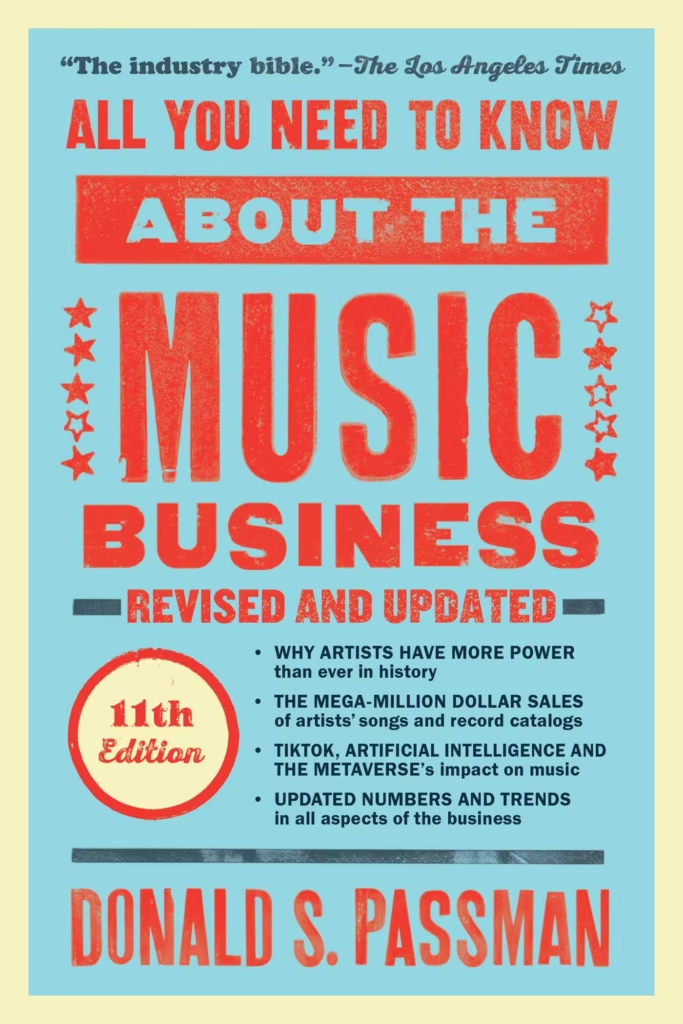
Donald S. Passman’s All You Need to Know About the Music Business is widely considered the definitive bible for navigating the modern music industry. Now in its 11th edition, the book has been continuously updated to reflect seismic shifts like the dominance of streaming, the rise of TikTok, the emergence of AI-generated music, Web3, NFTs, and the massive sale of music catalogs.
The core premise is simple but vital: Most successful artists (like brain surgeons) can be brilliant at their craft while knowing almost nothing about the business side of their careers. This book serves as a “jungle map,” designed to help artists, managers, lawyers, and entrepreneurs understand the complex structures of record deals, publishing, touring, merchandising, and film music. Passman argues that no one will ever take better care of your business than you, and this book provides the foundational knowledge to do so.
The book begins by stressing that an artist is a business. Because most artists dislike or are not skilled in business, they must hire a professional team. However, choosing the wrong team can be disastrous.
Personal Manager: The most critical person, acting as the CEO. They help with creative decisions, career strategy, and assembling the rest of the team. They typically earn 15-20% of gross earnings. Passman details crucial contract points, including “sunset clauses” that limit how long a manager gets paid after you part ways.
Business Manager: Handles all money: collecting fees, paying bills, filing taxes, and overseeing investments. Crucially, no credentials are required to be a business manager in many states, so careful vetting is essential. They usually charge a percentage (around 5%), hourly fees, or a flat monthly retainer.
Attorney: More than just contract reviewers, good music lawyers have industry clout and relationships that help get deals done. Fees can be hourly ($400–$1,500+), a percentage (5%), or value-based.
Agent: Primarily books live concert tours (and some endorsements). Their sphere is more limited than managers or lawyers. Agents typically take 10% of gross touring income.
This is the heart of the book, explaining the complex economics of recorded music.
The Streaming Revolution: Passman explains how the business collapsed due to piracy (revenues fell from $14.6B in 1999) but has now rebounded to an all-time high (over $15.9B) thanks to streaming. However, streaming has radically changed the model:
From Sales to Streams: Artists are no longer paid per album sold but per stream. The more a song is streamed, the more money it makes.
The Pro-Rata Pool: Streaming services (Spotify, Apple Music) pool all subscription and ad revenue, then pay rights-holders based on their share of total streams. This means if a major artist like Taylor Swift has a huge month, it slightly reduces the per-stream payout for everyone else.
ARPU (Average Rate Per User): Passman explains why Apple Music (subscription-only) pays more per stream than Spotify (which has a large, low-revenue free tier).
Royalties and Advances: The book demystifies how artists get paid.
Royalties: For downloads/physical products, royalties are a percentage (typically 15-22% for new artists to superstars) of the wholesale price. For streaming, you get a percentage of the label’s revenue from the DSP (Digital Service Provider).
Advances: Money given upfront, recoupable from future royalties (like a loan against future earnings). The book explains “recoupment,” “cross-collateralization” (where losses on one album can be recouped from profits on another), and “360 deals” where labels take a cut of touring, merch, and publishing income.
Producer & Mixer Deals: Producers (who guide the creative process) typically get 3-4% of record royalties, often paid “from record one” after recording costs are recouped, which can leave the artist owing the producer before the artist is paid.
This section explains the difference between the song (the composition) and the recording (the master). Songwriting income is often more lucrative and lasts longer.
Copyright Basics: A copyright is a “limited duration monopoly” that gives the owner exclusive rights to reproduce, distribute, perform, and create derivative works. The moment you fix a song in tangible form (write it down or record it), you have a copyright—registration is not required for ownership but is necessary to sue infringers.
Performing Rights vs. Mechanicals:
Performing Rights: Money earned when a song is played publicly (radio, TV, live venues, streaming). Collected by PROs like ASCAP, BMI, SESAC, and GMR, which pay the songwriter directly.
Mechanical Royalties: Money earned when a song is reproduced (CDs, downloads, interactive streaming). For physical/downloads, the statutory rate is currently 12¢ per song. For streaming, mechanicals are a complex percentage of revenue (e.g., 15.1% of service revenue in 2023).
The Music Modernization Act (MMA): Passman explains this landmark 2018 law, which created the Mechanical Licensing Collective (MLC) to solve the problem of unmatched streaming royalties, ensuring songwriters get paid more efficiently.
Songwriter & Co-Publishing Deals: Songwriters typically sign deals where they get 75% to 90% of income, with the publisher taking the rest for administration (licensing, collection, promotion).
Touring: The book notes that new artists almost always lose money touring (using “tour support” from labels). Success is measured by profit splits, not just guarantees. Superstars get 85-90% of net profits or 65-70% of gross ticket sales. Passman provides a crucial insight: Saving $1 in expenses puts more money in your pocket than earning $1 more in revenue, because commissions (manager, agent) are taken off the top of revenue but not off cost savings.
Merchandising: Tour merch (T-shirts, hoodies) is a major revenue source. Artists typically get 75-80% of net profits from tour sales, but must pay “hall fees” (20-25% of gross) to the venue. Bootlegging (illegal outside sales) remains a serious problem.
This advanced section covers the highly complex world of licensing music for films. Passman notes that a single song in a movie may require eight separate deals (performer, record label, songwriter, publisher, producer, etc.). Composers who write underscore (background score) rarely get publishing rights, while songwriters for films can often negotiate a share. The book also covers synchronization licenses (using music with visuals), music supervisor roles, and soundtrack album deals.
AI (Artificial Intelligence): Passman addresses emerging copyright questions: Who owns an AI-generated song? Current law (as seen in the “Monkey Selfie” case) requires a human author. This area is rapidly evolving.
Catalog Sales: Explains the recent boom in artists (Bob Dylan, Bruce Springsteen) selling their song catalogs for hundreds of millions, driven by low interest rates and streaming growth, and analyzes the pros and cons of selling.
Web3, NFTs, and the Metaverse: Discusses virtual concerts (e.g., in Fortnite), digital merchandise (skins, avatars), and NFTs (non-fungible tokens). While a potential future revenue stream, the book notes this area is still nascent and cooling after an initial hype cycle.
Passman’s book is a comprehensive, practical, and surprisingly readable guide to an extraordinarily complex industry. It demystifies legalese and financial jargon, empowering musicians and businesspeople alike to negotiate better deals, avoid common pitfalls (like uncontrolled “controlled composition” clauses or predatory management contracts), and protect their intellectual property.
The central takeaway remains: Your talent is your product, but knowledge of the business is the engine that converts that product into a sustainable career. Whether you are a DIY artist, a signed superstar, or an aspiring manager, this book provides the foundational “map” needed to navigate the jungle of the modern music business without getting lost or taken advantage of.