
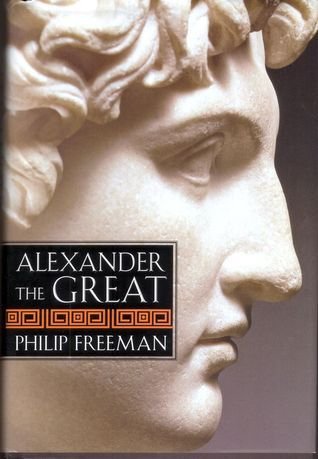
Alexander the Great by Philip Freeman is a vivid, authoritative biography of history’s most iconic conqueror. From his youth under Aristotle to his undefeated military campaigns across Asia, Freeman reveals how Alexander built a vast empire and reshaped the ancient world. This engaging narrative captures both his brilliance and his flaws, offering timeless insights into leadership, ambition, and the enduring power of legacy.
Alexander the Great by Philip Freeman is a compelling and accessible biography of one of history’s most legendary figures, offering a balanced, well-researched account of Alexander’s life, conquests, and legacy.
Freeman, a classical scholar and historian, presents the first major biography of Alexander written for a general audience in over a generation. He combines ancient sources like Plutarch, Arrian, and Diodorus with modern scholarship to paint a vivid portrait of the young Macedonian king who built an empire stretching from Greece to India.
“He was not just a conqueror, he was a force of nature.”
This summary walks you through the core narrative and insights of Freeman’s book, exploring how Alexander rose to power, led his armies across continents, reshaped the ancient worldand ultimately died at the peak of his power, leaving behind a legend that has endured for over two millennia.
Alexander was born in 356 BCE in Pella, the capital of the kingdom of Macedonia. Son of King Philip II and Queen Olympias, he was raised in a world of political intrigue, military ambition, and Greek intellectual tradition.
At just thirteen years old, he was placed under the tutelage of Aristotle, one of the greatest minds of the ancient world. From Aristotle, Alexander learned philosophy, science, medicine, and literature, especially Homer’s Iliad, which became his personal guidebook.
“He carried a copy of the Iliad throughout his campaigns, believing himself a new Achilles.”
When Philip II was assassinated in 336 BCE, the twenty-year-old Alexander inherited a powerful army and a fragile alliance of Greek city-states. Rather than consolidate quietly, he acted swiftly, crushing rebellions, securing loyalty, and proving himself a leader of unmatched determination.
Freeman emphasizes that Alexander was more than a warrior—he was a brilliant strategist, charismatic leader, and visionary ruler.
His leadership style included:
“Alexander didn’t just command armies—he inspired them.”
One of his earliest tests came when Thebes rebelled against Macedonian rule. Alexander responded with brutal speed, destroying the city as a warning to others. It worked, the rest of Greece submitted without further resistance.
In 334 BCE, Alexander launched his most ambitious campaign: the invasion of the Persian Empire, then the largest and wealthiest empire in the world.
With an army of about 40,000 men, he crossed the Hellespont into Asia Minor and immediately engaged the Persians at the Battle of Granicus River. Against overwhelming odds, he won, a victory made possible by bold tactics and personal courage.
Over the next eight years, Alexander would defeat three successive Persian kings, Darius III being the most prominent, and dismantle their vast empire.
Key battles include:
“Where others saw impossibility, Alexander saw opportunity.”
After Gaugamela, Alexander entered Babylon, Susa, and Persepolis—the heart of the Persian Empire. There, he allowed his troops to loot the royal palace, symbolizing the fall of Persia.
Freeman details how Alexander did not stop at Persia. Driven by curiosity, ambition, and a desire to reach the “ends of the earth,” he pushed eastward into regions few Greeks had ever seen.
In 332 BCE, Alexander was welcomed as a liberator from Persian rule. He founded the city of Alexandria, which would become a center of learning and culture.
He also made a daring journey to the Oracle of Siwa in the Libyan desert, where he was declared the son of the god Amun—linking him to divine status in Egyptian eyes.
From 330–327 BCE, Alexander campaigned through modern-day Afghanistan and Uzbekistan. This was some of his hardest fighting—against guerrilla forces in rugged terrain.
During this time, he married Roxana, a Bactrian princess, in a move that blended politics with personal affection.
In 326 BCE, Alexander crossed the Indus River and fought King Porus at the Battle of the Hydaspes. Though victorious, his exhausted army refused to go further after encountering war elephants and monsoon rains.
“Even the gods could not have compelled them to march on.”
Reluctantly, Alexander turned back, ending his eastward expansion.
Freeman doesn’t portray Alexander as a flawless hero. Instead, he reveals a complex, contradictory figure:
“Alexander was both magnanimous and cruel, generous and impulsive.”
His personality was shaped by intense competitiveness, a need for glory, and an almost superhuman drive to win.
Despite his success, Alexander’s empire began to crumble even before his death.
Freeman explains:
Still, Alexander’s impact was profound:
“He didn’t set out to spread Greek culture, but he did.”
While his political empire fractured, his cultural legacy endured.
Freeman draws timeless lessons about leadership from Alexander’s life:
Alexander never asked his men to do what he wouldn’t do. He marched, fought, and suffered alongside them.
He didn’t just conquer—he offered a vision of a unified world.
He adopted foreign customs, promoted local leaders, and respected diverse beliefs.
His failure to recognize his army’s limits in India showed even great leaders can misjudge morale.
The closer he got to godhood, the lonelier and more volatile he became.
“Greatness demands sacrifice, not just from followers, but from the leader.”
Alexander’s influence extends far beyond antiquity.
Freeman shows how:
Even today, his name evokes awe and mystery.
“Few people have changed the course of history so dramatically in such a short life.”
Born at nineteen, dead by thirty-two, he achieved more in twelve years than most rulers do in decades.
Freeman explores what drove Alexander:
“He couldn’t tolerate losing, even if it meant winning everything.”
This relentless drive made him unstoppable, but also unsustainable.
Alexander’s success wasn’t luck, it was strategy.
Freeman highlights key tools:
“Victory comes not from size, but from agility and will.”
Alexander embodied several radical mindsets:
These shifts allowed him to transcend the limitations of his time.
Freeman concludes that Alexander was less a nation-builder and more a transformative force.
“He burned brightly and briefly, like a comet across the sky of history.”
His empire didn’t survive, but his ideas did. The fusion of Greek and Eastern cultures laid the foundation for centuries of exchange in art, science, and philosophy.
As Freeman writes:
“Without Alexander, the ancient world would have been smaller, more divided, and less connected.”
Alexander may have sought glory, but his unintended legacy was globalization in the ancient world.