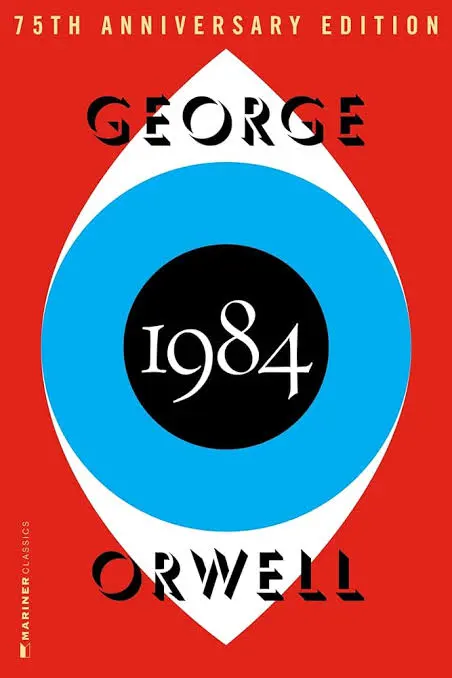
George Orwell’s 1984 is a dystopian masterpiece that presents a chilling vision of a totalitarian future where individual freedom, truth, and even reality itself are systematically obliterated by an all-powerful state. Set in the fictional superstate of Oceania, formerly Great Britain, now “Airstrip One”, the novel follows Winston Smith, a low-ranking member of the ruling Party, as he struggles to retain his humanity, memory, and sense of truth in a world governed by surveillance, propaganda, and psychological manipulation.
The story opens on April 4, 1984, in a decaying London dominated by the omnipresent image of Big Brother, the enigmatic leader of the Party. The city is marked by poverty, perpetual war, and constant surveillance via telescreens and the Thought Police. Winston works at the Ministry of Truth, where his job is to rewrite historical records to align with the Party’s ever-changing version of reality, a practice known as “rectification.” Despite outward compliance, Winston harbors deep resentment toward the Party and begins to rebel in small but significant ways: he starts a secret diary, engages in forbidden thoughts (“thoughtcrime”), and eventually embarks on a clandestine love affair with Julia, a fellow Party member.
Winston’s rebellion is not merely political, it is deeply personal and philosophical. He clings to the belief that objective truth exists, that the past is real and immutable, and that human emotions like love and loyalty cannot be entirely extinguished. These convictions place him in direct opposition to the Party’s core doctrine: that reality is whatever the Party says it is. This philosophy is encapsulated in the Party’s slogans: “WAR IS PEACE,” “FREEDOM IS SLAVERY,” and “IGNORANCE IS STRENGTH.” Through mechanisms like Newspeak (a language designed to eliminate rebellious thought by restricting vocabulary), doublethink (the ability to hold two contradictory beliefs simultaneously), and relentless surveillance, the Party seeks not just obedience, but total mental conformity.
Winston’s hope for resistance centers on two figures: Julia and O’Brien. Julia, though politically apathetic, shares his hatred of the Party’s control over personal life. Their relationship becomes a sanctuary of authenticity, pleasure, and fleeting freedom. They rent a room above Mr. Charrington’s junk shop, a space without a telescreen, where they imagine building a private world untouched by the Party. Meanwhile, Winston believes O’Brien, a high-ranking Inner Party member, is part of a secret resistance movement called the Brotherhood, inspired by the Party’s archenemy, Emmanuel Goldstein. Winston’s faith in O’Brien is based on a shared glance during a Two Minutes Hate session, an unspoken understanding that seems to confirm they are allies.
This hope culminates when O’Brien invites Winston and Julia to his home, where he appears to initiate them into the Brotherhood. He gives them a copy of Goldstein’s forbidden book, The Theory and Practice of Oligarchical Collectivism, which explains the true nature of the Party’s rule: power is not a means to an end, but an end in itself. The Party maintains perpetual war, poverty, and fear not to benefit the people, but to ensure its own absolute control. The book argues that the proles (the working class) are the only hope for revolution, but Winston realizes too late that this is a trap.
Soon after reading the book, Winston and Julia are arrested. The room above Mr. Charrington’s shop was under surveillance all along; Charrington himself is revealed to be a member of the Thought Police. The couple is taken to the Ministry of Love, where they are tortured and interrogated. Winston learns that O’Brien was never a rebel, he is a loyal agent of the Party whose mission is to break Winston’s spirit and re-educate him into loving Big Brother.
In the Ministry of Love, Winston undergoes brutal physical and psychological torture. O’Brien explains that the Party’s goal is not mere obedience, but the complete eradication of independent thought. “We do not destroy the heretic because he resists us,” O’Brien says. “We convert him… We make him one of ourselves before we kill him.” The Party seeks to control not just actions, but the inner mind, so thoroughly that even the desire to rebel is extinguished.
Winston’s breaking point comes in Room 101, where prisoners face their worst fear. For Winston, it is rats. Confronted with a cage of ravenous rats fitted to his face, he betrays Julia in a moment of primal terror, screaming, “Do it to Julia! Not me!” This act shatters his last claim to moral integrity. His love for Julia, and his belief in any value beyond self-preservation, is destroyed.
After his release, Winston is a hollow shell. He frequents the Chestnut Tree Café, drinks gin, and plays chess, waiting for the bullet he knows will eventually come. He encounters Julia once more, and they admit they betrayed each other without hesitation. Any spark of rebellion or affection between them is gone. In the novel’s final, devastating lines, Winston sits before a telescreen broadcasting news of a great military victory. As he gazes at Big Brother’s image, he experiences a final, twisted epiphany: “He loved Big Brother.”
Orwell’s 1984 is not merely a warning against totalitarianism; it is a profound meditation on truth, memory, language, and the fragility of the human spirit. The novel illustrates how authoritarian regimes maintain power not just through violence, but by controlling information, rewriting history, and distorting language to narrow the range of thought. The Party’s ultimate triumph is not in forcing Winston to say “two plus two equals five,” but in making him believe it, and, more horrifyingly, to want to believe it.
The novel’s enduring relevance lies in its exploration of how truth can be manipulated, how language can be weaponized, and how institutions can manufacture consent through fear and repetition. Orwell shows that the most terrifying form of oppression is not external coercion, but internalized submission, the moment when the oppressed begin to love their oppressor.
Through Winston’s tragic arc, Orwell argues that freedom is not just the absence of chains, but the ability to think, remember, and feel authentically. When those capacities are destroyed, humanity itself is lost. 1984 remains a stark, urgent reminder that vigilance, critical thinking, and the defense of truth are essential to preserving not just democracy, but the very essence of what it means to be human.