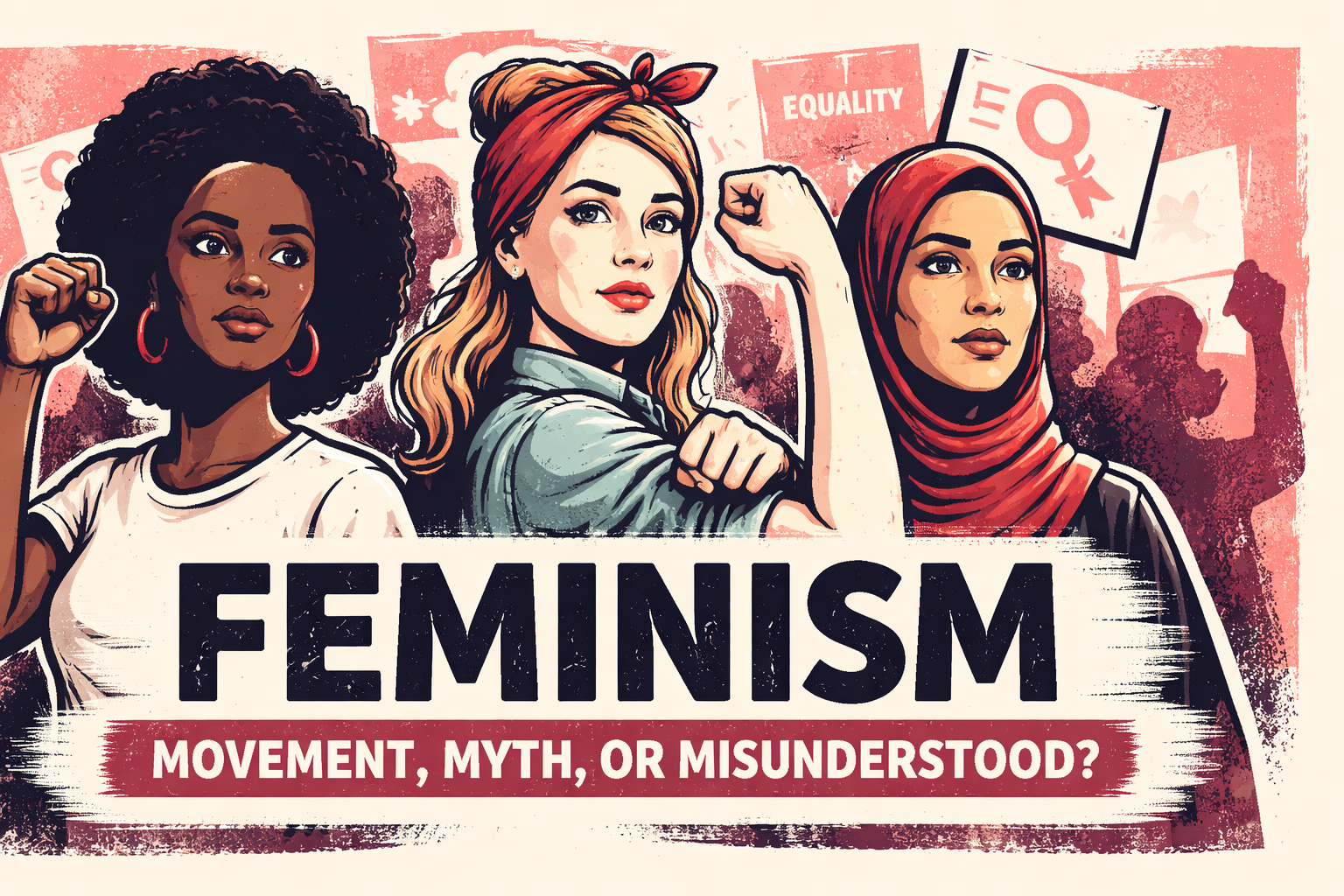
Feminism is commonly defined as the “advocacy of equal rights and opportunities for women.”
These days feminism is reduced to slogans, stereotypes or shouting matches. Feminism is simple: the belief that women and men deserve equal social, economic and political rights. Not superiority, not revenge. But equality.
But history complicates that simplicity.
For most of recorded history, women were legally and socially restricted. They couldn’t vote, own property freely, access higher education, or control their wages in many countries. In medieval Europe, women were barred from public life. In parts of 19th-century Germany, a husband could legally sell his wife. In the United States and much of Europe, women gained the right to vote only in the 20th century.
Supporters argue that the movement remains essential in addressing wage gaps, violence and systemic bias. Critics contend that modern feminism has shifted from seeking equality to advancing selective or ideological agendas.
The debate is not simply about whether feminism is “right” or “wrong.” It is about whether the movement today reflects its original purpose, equality or whether it has transformed into something more complex, and more controversial.
The waves and the shifts
First Wave: Legal Rights
The first wave (19th–early 20th century) focused on voting rights, property ownership and basic legal recognition. It was largely led by white, middle-class women. Many women of color and working-class women were not fully represented.
Second Wave: Social and Workplace Equality
The second wave (1960s–1980s) tackled workplace discrimination, reproductive rights, marital laws, and cultural expectations. Influential voices like Betty Friedan questioned the idea of the “perfect housewife.” Organizations such as the National Organization for Women pushed for equal pay and anti-discrimination laws.
This wave popularized the idea that “the personal is political”, meaning issues inside the home (domestic violence, marital rape, unpaid labor) were not private matters but systemic concerns.
Third Wave: Identity and Inclusion
In the 1990s, the third wave emerged. It emphasized individuality, sexuality, and diversity. Feminists like Rebecca Walker argued that feminism needed to include race, class, sexuality and global perspectives.
It became less about one unified definition and more about multiple voices.
Fourth Wave: Digital Activism
Around 2012, many argue a fourth wave began, centered on online activism and sexual harassment. Movements like Me Too movement gained global attention after allegations against Harvey Weinstein surfaced. Social media became a tool for accountability and awareness.
Achievements Attributed to Feminist Movements
Whether one identifies as a feminist or not, several measurable changes occurred alongside feminist activism:
-
Women gained voting rights across much of the world.
-
Access to higher education expanded significantly.
-
Laws addressing workplace discrimination and domestic violence were introduced.
-
Female representation in professions and politics increased.
These outcomes altered social and economic landscapes. The argument from supporters is straightforward: without organized feminist movements, many of these changes would have been delayed or resisted.
Where the Debate Begins
Now here’s where things get real. Not everyone agrees on what feminism is or should be. Some define it strictly as equal legal rights and argue that in many developed countries, those rights already exist. From this view, feminism has either achieved its main goals or shifted toward social issues that are more subjective.
Others argue that equality on paper does not guarantee equality in practice. They point to wage gaps, underrepresentation in leadership, unpaid domestic labor, and cultural expectations that still limit women’s choices.
There are also internal disagreements:
-
Should feminism focus on strict equality, even if that removes certain protections (like maternity benefits)?
-
Should it prioritize economic class over gender?
-
Has it become too Western-centric when applied globally?
-
Does modern feminism sometimes dismiss traditional roles instead of respecting choice?
These are not small questions. They divide feminists themselves.
Criticism of Feminism
Critics argue that:
-
Some branches of feminism have become hostile toward men.
-
Certain movements focus more on ideology than practical solutions.
-
In some spaces, dissenting women are labeled instead of debated.
-
It sometimes overlooks men’s issues (such as suicide rates, custody bias, workplace fatalities).
Supporters respond that:
-
A movement centered on women does not automatically exclude concern for men.
-
Highlighting systemic patterns is not the same as attacking individuals.
-
Social progress often feels disruptive before it feels fair.
Global Complexity
Feminism looks different depending on geography. In some countries, women still fight for access to education, protection from forced marriage or basic legal safety. In others, debates center on boardroom representation or gender language in media.
Western feminism has sometimes been criticized for assuming its priorities apply everywhere. Women in developing nations have argued that poverty, war, and access to clean water are more urgent than academic gender theory.
Context matters.
Feminism in Everyday Life
Feminism is associated with protests, policies, and political debates. Yet in everyday life, it appears in quieter forms. It is present when women pursue higher education, build careers, or expect equal partnership at home. These choices, once restricted, are now considered ordinary.
However, everyday experiences still reveal subtle inequalities. Women may enter workplaces in equal numbers but remain underrepresented in leadership. Domestic responsibilities are often unevenly distributed, even in modern households. Ambition in women can still be judged differently than ambition in men.
Because these issues are less visible than legal barriers, they are sometimes overlooked. The assumption that equality has already been achieved can make ongoing disparities seem insignificant.
In this sense, feminism exists not only in public movements but in daily negotiations in expectations, opportunities, and responsibilities that shape ordinary life.
The Real Question
Is feminism still necessary? That depends on what you believe equality means.
If equality means identical outcomes, the debate becomes complex.
If equality means equal opportunity under law and culture, then the question becomes whether that opportunity is fully realized everywhere.
The honest conclusion is this: feminism is neither pure myth nor flawless movement. It is a historical force shaped by human beings with strengths, blind spots, victories, and contradictions.
Understanding it requires separating emotional reactions from documented history.
And deciding whether it is right or wrong?
That part is yours.
Because movements don’t define themselves by slogans.
They are defined by what they achieve and what they fail to address.
Be kind. Be honourable.