

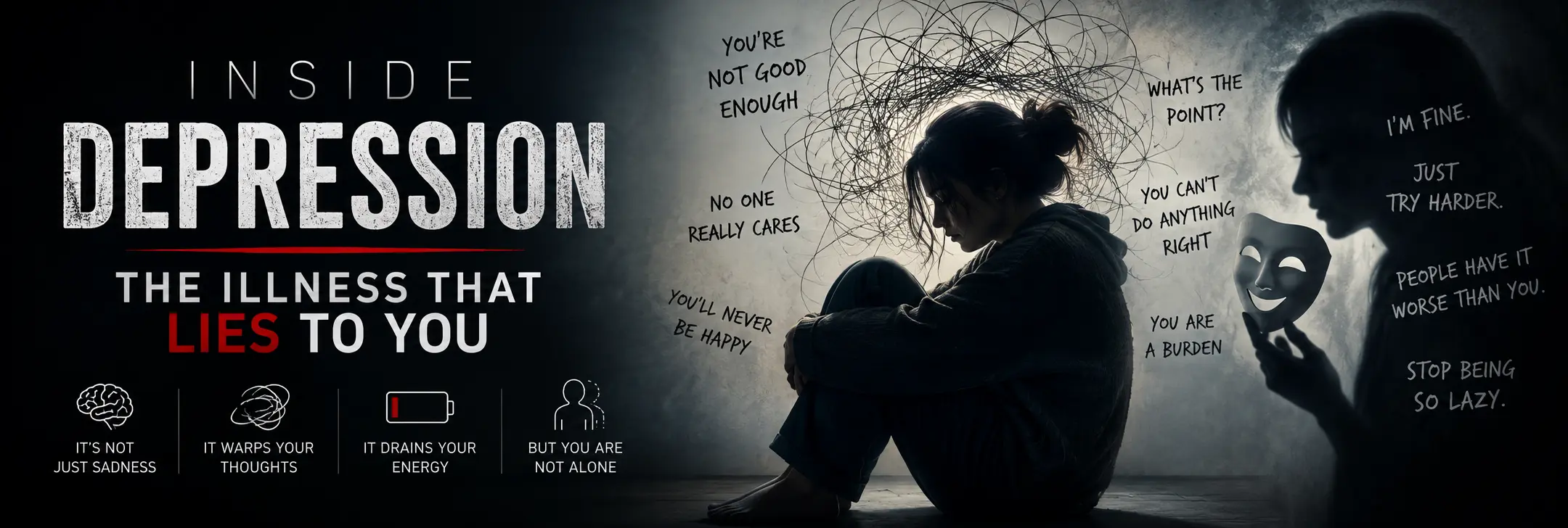
When people hear the word depression, they often imagine someone sitting alone in a dark room, crying endlessly. However, depression can look like laughing at a joke while feeling completely empty inside. It can look like replying “I’m fine” because explaining how you truly feel seems more exhausting than pretending. It can look like sleeping for twelve hours and still waking up tired, or lying awake all night because your thoughts refuse to rest.
Sometimes, depression doesn’t steal your happiness first. It steals your interest.
The music you once loved becomes noise. The hobbies that once excited you begin collecting dust. Conversations feel like work. Replying to a message becomes another task for “later.” Even getting out of bed can feel like climbing a mountain without knowing why.
This is what makes depression so dangerous. From the outside, a person may look completely normal. Inside, they’re fighting a battle that nobody else can see.
Depression isn’t simply an emotion. It affects your body, your concentration, your memory, your sleep, your appetite, your energy, and even the way your brain interprets reality.
Depression appears in many forms:
There are different types of depression, each with its own symptoms, causes and level of severity. The risk of developing depression is influenced by a combination of genetic factors, life experiences, and stressful or traumatic events.
Major Depressive Disorder (MDD)
Major Depressive Disorder is the most common type of depression. It involves experiencing symptoms such as persistent sadness, loss of interest in activities, exhaustion, lack of motivation, changes in sleep or appetite, feelings of hopelessness, and difficulty concentrating for at least two weeks.
Doctors usually classify it as mild, moderate, or severe, depending on the number and intensity of symptoms. Some people experience only one depressive episode in their lifetime, while others have repeated episodes over the years. When depression keeps returning, it is known as recurrent depressive disorder.
Persistent Depressive Disorder (PDD)
Also called chronic depression, this is a long-lasting form of depression that continues for more than two years. The symptoms may not always be as severe as those of Major Depressive Disorder, but there are no phases of relief from the symptoms.
In some cases, a person with Persistent Depressive Disorder also develops a major depressive episode, a condition known as double depression.
Postpartum Depression
After childbirth, many new mothers experience temporary emotional changes known as the “baby blues.” These may include mood swings, sadness, anxiety, and irritability, and they usually resolve within about two weeks.
Postpartum (or postnatal) depression is more severe and lasts longer than the baby blues. Mothers with postpartum depression may have difficulty caring for themselves or their baby. They often feel misunderstood because people around them expect them to feel only joy and happiness after giving birth. This can lead to feelings of guilt, shame, and inadequacy for not being able to enjoy motherhood as expected.
Bipolar Disorder
Depression is sometimes part of a condition known as bipolar disorder or manic depression. People who have bipolar disorder experience alternating phases involving extreme mood swings.
People with bipolar disorder alternate between depressive episodes and periods of mania or hypomania. During these episodes, they may feel unusually energetic, confident, and euphoric, require very little sleep, think rapidly, speak excessively, or engage in impulsive and risky behaviours. In severe cases, they may lose touch with reality.
What Happens Inside the Brain?
Your brain communicates through chemicals called neurotransmitters. Three of the most important are:
- Serotonin, which helps regulate mood, sleep, and emotional stability.
- Dopamine, which plays a major role in motivation, reward, and the feeling that something is worth doing.
- Norepinephrine, which influences alertness, attention, and energy.
In depression, these systems may function differently than in normal condition. Brain imaging has shown changes in several important regions.
The prefrontal cortex, responsible for planning, decision-making, and self-control, often becomes less active. Everyday choices can suddenly feel overwhelming.
The amygdala, the brain’s emotional alarm system, may become more reactive, making negative emotions feel stronger and harder to regulate.
The hippocampus, which helps with memory and learning, can be affected by prolonged stress. High levels of the stress hormone cortisol over long periods are associated with changes in this area in some people.
Researchers are also studying the role of chronic inflammation, genetics, and life experiences. Rather than one single cause, depression is now understood as the result of many biological, psychological, and environmental factors interacting with one another.
Why Is It So Hard to Get Out?
One of the cruelest parts of depression is that it creates a cycle. Stress or emotional pain can reduce motivation.
Reduced motivation makes everyday tasks feel impossible. When tasks are avoided, people may become isolated, stop exercising, neglect sleep, or withdraw from activities they once enjoyed.
These changes can worsen mood, making motivation drop even further. The cycle repeats.
Depression often convinces people that nothing they do will make a difference.
The brain begins filtering experiences differently. Negative memories become easier to recall. Positive moments feel smaller. Future possibilities seem distant or impossible.
When people say, “think positively,” they’re asking a brain affected by depression to function as though it isn’t depressed. If it were that simple, depression wouldn’t exist.
Can Depression Be Treated?
Yes.
Depression is one of the most treatable mental health conditions, although recovery looks different for everyone. For some people, therapy is enough. Others benefit from medication.
Many recover through a combination of professional treatment, supportive relationships, healthy routines, physical activity, good sleep, and time. Depression thrives when it convinces you to stop engaging with life. Recovery often begins when, despite everything your mind is telling you, you take one small step forward anyway.
Final Thoughts
Depression lies. It tells people they are alone when they are not.
It tells them they are a burden when they matter deeply to others.
It tells them tomorrow will never be different from today.
Those are some of its most convincing and most dangerous illusions.
Recovery is rarely fast. It isn’t linear, and it doesn’t mean every difficult day disappears. But brains can change. People can heal. With the right support, treatment, and patience, many do.