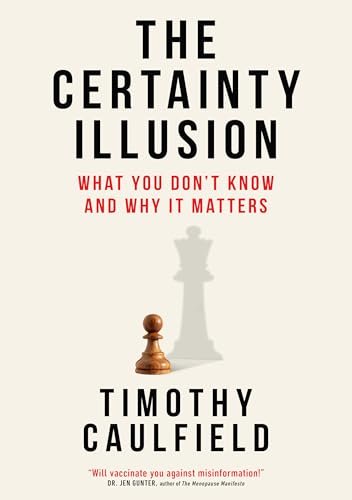
Book Summary: The Certainty Illusion by Timothy Caulfield
The Core Problem: We live in a glorious time for knowledge. More information is available to more people than ever before in human history. Yet, paradoxically, we have never been less certain about anything. Our information environment is “completely and truly f*cked”—a tangle of lies, distortions, and rage-filled rants. The tools we rely on to find clarity—science, expert opinions, and our sense of what is “good”—are being systematically corrupted. This is The Certainty Illusion: the more we seek trustworthy guidance, the more the information economy is incentivized to spin, exploit, and fake that guidance.
Timothy Caulfield, a renowned science and health policy expert, argues that we are not just in a misinformation crisis; we are in a knowledge production crisis. The lighthouses that should guide us through the storm are being torn down. This book is an urgent, evidence-based investigation into how we got here and, more importantly, how we can find a path forward.
Part I: The Science Illusion
Science is our most powerful tool for understanding the world. But its cultural authority has made it a prime target for manipulation. Caulfield calls this scienceploitation: using science-y language to sell products, ideas, and agendas.
You see it everywhere. “Quantum” is tacked onto everything from homeopathy to intimacy coaching, not because quantum physics is relevant, but because it sounds profound and mysterious. “Stem cells” are used to sell anti-aging creams and unproven therapies, even though real stem cell treatments are extremely rare. During COVID, “immune-boosting” became a multi-billion-dollar marketing scam. This strategy works because science-y jargon creates a veneer of credibility, making nonsense seem legitimate.
But the problem isn’t just external hucksters. The academic research system itself is broken. Scientists are under immense pressure to publish, secure grants, and generate hype. This has led to:
-
A 1400% increase in hype language in successful NIH grant applications since 1985.
-
A flood of predatory journals (over 11,000 of them) that will publish anything for a fee. One researcher submitted a paper consisting entirely of the phrase “Homeopathy is pseudoscience BS” repeated six times, and it was accepted.
-
Hijacked journals where scammers create fake websites of real publications to steal fees.
-
Zombie science, like the infamous retracted 1998 Wakefield study falsely linking vaccines to autism, which continues to be cited and believed years after being proven fraudulent.
Caulfield’s conclusion is sobering: the trust and credibility of science are being used to destroy the trust and credibility of science.
Part II: The Goodness Illusion
We all want to do what is right—for our health, our families, and the planet. This desire for “goodness” is another guidepost that is relentlessly exploited.
Health halos are words or phrases that make a product seem healthier, safer, or more virtuous than it really is. “Natural,” “organic,” “non-GMO,” “clean,” “chemical-free,” “locally grown,” “gluten-free,” and “toxin-free” are everywhere. But these terms are often scientifically meaningless or deeply misleading.
-
“Natural” has no legal definition and is based on the logical fallacy that what is natural is inherently good (arsenic is natural; so are deadly mushrooms).
-
“Non-GMO” is a marketing triumph built on a lie. The scientific consensus is clear: GMOs are safe to eat. Yet the gap between scientific consensus (safe) and public perception (dangerous) is larger for GMOs than for climate change or vaccines.
-
“Clean beauty” has no definition and is often used to sell products that are no safer, and sometimes more allergenic, than conventional ones.
-
“Locally grown” sounds great, but transportation accounts for only a small percentage of a food’s environmental footprint. A local farm may be less efficient and worse for the planet than a large farm farther away.
Even our pets are not spared. Grain-free pet food, a $100 billion industry, has no proven health benefits and may actually cause heart problems in dogs.
This goodness illusion also extends to more insidious areas. Caulfield explores the rise of “bro-science” and the manosphere wellness industry, where figures like Tucker Carlson promote absurd practices like “testicle tanning” to boost testosterone. This isn’t just harmless nonsense; traditional masculinity norms are associated with poorer health outcomes, less help-seeking, and increased aggression.
The key takeaway: when a product or idea is marketed using a health halo, be deeply suspicious. It is exploiting your desire to do good, not providing evidence-based guidance.
Part III: The Opinion Illusion
Online reviews and rankings have become the third great guidepost of our age. We trust a five-star average from strangers more than the opinions of experts or even our own friends and family. But this opinion economy is a house of cards.
Caulfield tells the hilarious and horrifying story of Oobah Butler, who created a fake restaurant called “The Shed at Dulwich” in his backyard, complete with a burner phone and a cryptic website. He posted a series of fake, florid reviews on TripAdvisor. Within a few months, his non-existent restaurant was ranked #1 in the entire city of London. People from all over the world tried to book tables.
The reality is that an estimated 25-40% of all online reviews are fake or manipulated. Companies buy positive reviews, post fake negative reviews about competitors, and use incentives to skew ratings. Search engine algorithms reward high ratings with better visibility, creating a vicious cycle of fakery.
Even genuine reviews are profoundly biased. People who write reviews are rarely average consumers; they are either those who loved something or hated it. Reviews are influenced by the weather, the reviewer’s mood, herd mentality, and cultural biases. Studies have found that online consumer ratings of products bear almost no relationship to objective expert assessments of quality. For physicians, online ratings do not predict clinical outcomes.
Caulfield’s advice is blunt: you probably cannot spot a fake review, so be very skeptical. Seek out independent expert reviews that do comparative analysis. But most of all, recognize that our desperate search for certainty has created an opinion economy that is fundamentally rigged.
The Path Forward: Six Strategies
Despite the bleak diagnosis, Caulfield offers a constructive path forward, both for individuals and for society.
For individuals, he offers “The Certainty Six”:
-
Pause. Our cognitive biases make us share misinformation without thinking. Simply taking a beat to ask “Is this accurate?” before you hit share can make a huge difference.
-
Watch for scienceploitation. Be extra suspicious of claims that use hot topics like “quantum,” “stem cells,” or “microbiome” to sell something.
-
Resist hype. If a claim sounds too good to be true, it almost certainly is. Real scientific progress is slow and incremental.
-
Question “goodness” as a marketing strategy. “Natural,” “clean,” and “non-GMO” are often meaningless. Look at the actual ingredients and evidence.
-
Consider the body of evidence. Don’t fall for a single study. What does the scientific consensus say? Seek out trusted voices that aggregate science responsibly.
-
Like what you like. Ignore online reviews. Seek independent expert advice, talk to real humans, and keep an open mind.
For society, systemic changes are urgently needed:
-
Overhaul research funding to reward quality, not quantity. Use lotteries for grants and stop the publish-or-perish pressure that fuels predatory journals.
-
Speed up the retraction process for bad science and make retractions immediately obvious in search results.
-
Regulate fake reviews and hold platforms accountable.
-
Support science communication and critical thinking education.
The Bottom Line
The Certainty Illusion is not a comfortable read, but it is an essential one. Timothy Caulfield masterfully diagnoses the deep, structural problems that have turned our information ecosystem into a swamp of lies and distortions. He shows that the guideposts we rely on—science, goodness, and opinion—are not just failing; they are being actively exploited.
But the book is ultimately a call to action, not a cry of despair. By understanding the illusions, pausing before we share, and demanding systemic change, we can rebuild the lighthouses. We can navigate through the storm and find a path back to a world where evidence, not illusion, guides our most important decisions. As Caulfield writes, “We can and must build up and protect those lighthouses. Without them, we are truly lost.”
Comments
2I’m not that much of a internet reader to be honest but your blogs really nice, keep it up! I’ll go ahead and bookmark your site to come back in the future. Cheers
F*ckin’ awesome issues here. I am very glad to look your post. Thank you so much and i’m looking forward to touch you. Will you kindly drop me a e-mail?