
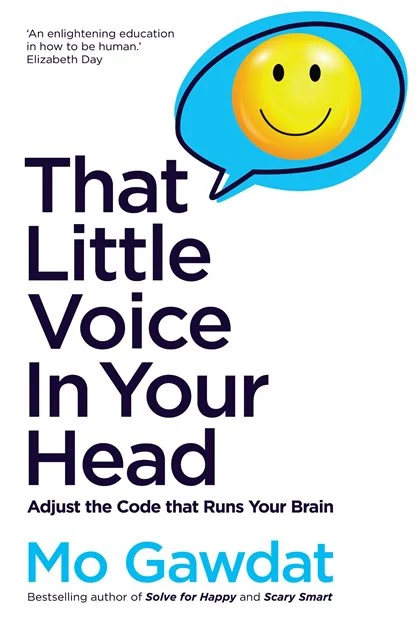

Summary of “That Little Voice in Your Head” by Mo Gawdat
Overview
Mo Gawdat, a former Google executive and author of Solve for Happy, returns with That Little Voice in Your Head, a practical guide to understanding and reprogramming the brain’s inner dialogue. Drawing from his background as a software engineer, Gawdat presents the brain as a highly predictable computer that runs on code. The problem isn’t that our brains are broken; it’s that we run them badly. By learning to debug our mental software, we can replace unhappiness with joy.
The book is deeply personal, inspired by the tragic loss of his son Ali, whose wisdom and peaceful nature became the catalyst for Gawdat’s mission to help one billion people find happiness.
The Core Framework: 4-3-2-1
Gawdat organizes the neural causes of suffering into a simple model:
4 Wrong Inputs that distort our perception of truth: conditioning (beliefs from our past), recycled thoughts (old negative patterns), trapped emotions (unprocessed feelings), and hidden triggers (media, news, social media, advertising). Most of what we think isn’t based on observation — it’s based on stories we’ve absorbed without questioning.
3 Exaggerated Defences rooted in our triune brain: the reptilian brain (aversion to threat), the mammalian brain (attachment to pleasure), and the rational brain (all-pervasive dissatisfaction — nothing is ever good enough). These defences kept our ancestors alive but now make us miserable.
2 Opposing Polarities — the left brain (analytical, doing, masculine) and right brain (intuitive, being, feminine). The modern world overvalues left-brain thinking, leaving us unbalanced. We need to learn to be before we do.
1 Harmful Thought — incessant thinking (rumination, the default mode network). A wandering mind is an unhappy mind. The voice in your head is not you; it’s a biological function, like urine or CO₂.
The Voice Isn’t You
One of Gawdat’s most liberating insights is that the little voice in your head is not you. It’s a third party — your brain talking to you. Drawing on neuroscience (the MIT study showing the brain solves problems first, then takes up to eight seconds to translate the answer into language), he argues that thinking is a biological product. “I think, therefore I am” is backwards. “I am, therefore my brain thinks” is closer to the truth.
This distinction matters because it means you don’t have to obey your thoughts. You can debate them, question them, and tell your brain to shut up.
The Four Wrong Inputs
Conditioning is the sum of all beliefs and traumas we’ve absorbed. It distorts reality. A successful Google country manager who fled war still felt unsafe despite having everything — because his childhood conditioning told him life couldn’t be trusted.
Recycled thoughts are old negative patterns we keep replaying. One thought — “She left me because I ate her yoghurt” — can trigger a cascade: “I’ll never find love again. I’ll die alone.”
Trapped emotions trigger thoughts constantly. Wake up irritated, and suddenly everything is against you.
Hidden triggers are the most dangerous: news media that hypernormalizes violence, social media that fuels comparison, advertising that manufactures dissatisfaction. Gawdat urges readers to opt out — stop watching violent movies, limit news consumption, curate social media feeds.
The Three Defences (AAA)
Aversion is fear-based avoidance. Your reptilian brain will invent absurd worst-case scenarios to keep you “safe.” But most of the time, you are safe.
Attachment is clinging to comfort. Your mammalian brain hoards things, relationships, and habits that no longer serve you.
All-pervasive dissatisfaction is the rational brain’s endless pursuit of more. Nothing is ever good enough. The antidote is gratitude — counting blessings every night.
Practice Makes Miserable
Thanks to neuroplasticity, the brain changes with use. If you practice self-criticism, you become excellent at it. If you practice gratitude, you become happier. The Biased Brain Test shows that most people can name something they dislike about themselves faster than something they like — proof that we’ve been practicing the wrong skills.
Emotions Are Predictable
Emotions aren’t mysterious. Every emotion is triggered by a specific thought. Envy = what another has minus what I have. Regret = what I wish I’d done minus what I did. Happiness = perception of events minus expectations.
Emotions left unexpressed don’t disappear — they fester. The modern world tells us to hide our feelings, but we only feel alive when we feel. Gawdat provides exercises to sit with emotions, embrace them, and release their physical signatures.
The Happiness Flow Chart
The book’s practical centerpiece is a decision tree for bouncing back to happiness:
-
Are you happy? If yes, enjoy it.
-
What do you feel? Identify the emotion.
-
What’s the trigger? Find the thought causing it.
-
Is it true? Challenge the thought. (Most thoughts about the past or future aren’t verifiable.)
-
Can you do something about it? If yes, take action. If no . . .
-
Can you accept and commit? Accept what you cannot change, then commit to making things better despite it.
Flow and Giving
Beyond problem-solving, Gawdat describes flow — the state where being and doing merge. Flow requires a task slightly harder than your current skill, no distractions, and focus on the micro-task rather than the end result.
Finally, giving is the most useful thought of all. Giving activates the brain’s reward system (dopamine, serotonin, oxytocin) and makes us happier than consuming. Money beyond basic needs doesn’t increase happiness, but giving does.
Conclusion
That Little Voice in Your Head is a user manual for the brain. Gawdat’s central message is optimistic: you are in control. Your brain is predictable and trainable. With deliberate attention, useful thinking, and daily practice, you can rewire yourself for happiness. The mission — OneBillionHappy, starts with each person changing their own little world, then spreading compassion outward. As Gawdat’s son Ali taught him: “You are never going to fix the world. You can only change your little world. Your little world is you.”