
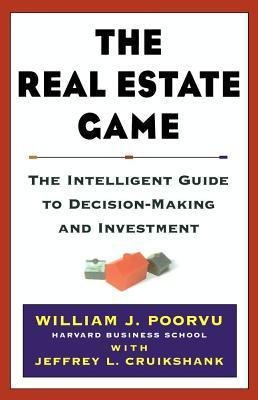

Summary of “The Real Estate Game” by William J. Poorvu
Overview
The Real Estate Game (1999) is a comprehensive guide to real estate investment and decision-making written by William J. Poorvu, a Harvard Business School professor with four decades of practical experience as a developer, owner, and investor. Co-authored with Jeffrey L. Cruikshank, the book demystifies real estate by framing it as a strategic “game” with identifiable rules, players, and phases.
Core Framework: The Game Diamond
Poorvu introduces the “game diamond” as a conceptual tool with four interconnected elements:
-
Properties: the physical assets (apartments, offices, hotels, industrial, retail)
-
Capital Markets: sources of debt and equity financing
-
Players: investors, developers, brokers, lenders, tenants, service providers
-
External Environment: economic cycles, tax policy, demographics, regulations, technology
Success requires assembling matching “cards” from all four decks. The game has five sequential phases: concept to commitment, commitment to closing, development, operations, and harvest.
Key Concepts
Back-of-the-Envelope (BOE) Analysis
Poorvu emphasizes simple, practical financial analysis over complex spreadsheets. Key metrics include:
-
Net Operating Income (NOI): revenue minus operating expenses
-
Cash Flow from Operations (CFO): NOI minus capital reserves and leasing costs
-
Return on Assets (ROA): CFO divided by purchase price
-
Return on Equity (ROE): cash flow after financing divided by equity invested
-
Capitalization Rate: current yield used to value income properties
BOE analysis helps investors quickly screen opportunities before committing significant time or money.
The Four Phases of Direct Investment
Phase 1: Concept to Commitment: Finding and evaluating opportunities, negotiating with sellers, building relationships with lenders, signing letters of commitment. Key skills: local market knowledge, financial analysis, negotiation.
Phase 2: Commitment to Closing: Due diligence (environmental, structural, legal, tenant issues), securing debt and equity financing, signing purchase and sale agreements, closing the deal. Warning: know when to walk away.
Phase 3: Development: Highest risk, highest reward. Land assembly, approvals, design, construction bidding, financing, marketing. Four pitfalls: inexperience, undercapitalization, external changes, ego.
Phase 4: Operations: Managing properties through tenant leases. The tenant lease is the central document covering rent, obligations, defaults, insurance, improvements, and termination.
Phase 5: Harvest: Exiting through sale or refinancing. Disincentives include transaction costs, prepayment penalties, capital gains taxes, and emotional attachment. Reasons to sell include market timing, partnership disputes, or funding new opportunities.
Property Types
The book analyzes five major property types:
| Type | Key Characteristics |
|---|---|
| Apartments | Stable income, low obsolescence risk, driven by household formation |
| Office | Most volatile, driven by job growth, long leases, high tenant improvement costs |
| Industrial | Least volatile, short development cycle, triple-net leases common |
| Hotel | Most operationally intensive, high leverage, correlated with GDP |
| Retail | Threatened by overbuilding and internet commerce, anchor tenants critical |
Indirect Investment Vehicles
-
Syndications — Limited partnerships for specific properties; investors must understand fee structures and profit splits
-
Pooled/Commingled Funds — Open-ended or closed-end funds for institutional investors
-
REITs (Real Estate Investment Trusts) — Publicly traded real estate securities; evaluate using Funds From Operations (FFO) and Adjusted Funds From Operations (AFFO)
Key Lessons
-
People matter more than properties — Relationships with brokers, lenders, partners, and tenants are critical
-
Buy wholesale, sell retail — Create value by buying below replacement cost and selling at market peaks
-
Manage risk, don’t seek it — Successful developers are risk managers, not gamblers
-
Operate profitably — The continuing tenant is the cheapest tenant
-
Know when to sell — Harvesting enables the next cycle of value creation
-
Add 10% contingency — Projects always cost more and take longer than planned
-
Follow the cash — Understand who gets what, when, and in what order
Notable Stories
Poorvu illustrates concepts with real examples: Bill Zeckendorf assembling land for the UN site (creativity overcoming obstacles), the JBG Companies buying Twinbrook Metro (value investing), Charlie Leonard’s Beacon Hill renovation (small-scale entry), and Cameron Sawyer’s Russian ventures (international development).
Real estate is presented as an exciting, people-driven field where general management skills, financial discipline, and relationship-building determine success. The book advocates value investing—buying at discounts to replacement cost, identifying catalysts for appreciation, and selling at the right juncture. While cyclical and challenging, Poorvu argues real estate remains “the best game around” for those willing to learn its rules.