
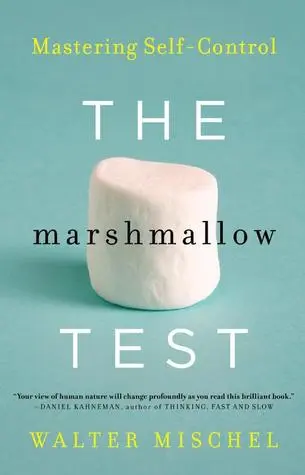
The Marshmallow Test reveals that willpower is not an inborn trait but a learnable cognitive skill. Drawing from five decades of research, psychologist Walter Mischel shows how mastering the “cool system” of the brain over the impulsive “hot system” predicts lifelong success in health, wealth, and relationships. Filled with practical strategies like self-distancing and implementation plans, this book proves that self-control can be taught to children and adults alike.
If you take away only one thing from this book, let it be this “Golden Code” :
Self-control is not an inborn trait you either have or lack. It is a set of cognitive skills you can learn, practice, and master. The key is learning to “cool” the present temptation and “heat” the future consequence.
In the 1960s, psychologist Walter Mischel designed a simple test at Stanford University’s Bing Nursery School. A preschooler was offered a choice: one marshmallow now or two marshmallows later if they could wait alone for up to 20 minutes.
What he saw was astonishing. Some children rang the bell in seconds. But others covered their eyes, turned their backs, sang songs, or pretended the marshmallow was just a picture. As one little girl named Lydia explained, “You can’t eat a picture!”
The Big Surprise: Decades later, the children who waited longer had dramatically better life outcomes. They scored an average of 210 points higher on SAT tests. They had lower body mass indexes (BMI) and better stress-coping abilities. They were less likely to use drugs and more likely to pursue and reach long-term goals.
Important Caveat: The test is not a destiny sentence. A child who eats the marshmallow is not doomed. The real power lies in understanding how the successful kids did it, because those strategies can be taught to anyone.
Mischel explains that your mind operates using two competing systems that are constantly fighting for control.
First, there is the Hot System. This is your emotional, reflexive, impulsive brain. It is centered in the amygdala, a primitive part of the brain that developed early in evolution. The Hot System is the “Go!” system. It screams for immediate gratification. It makes the preschooler ring the bell, the dieter grab the pizza, and the angry person lash out. It is activated by stress and desire.
Second, there is the Cool System. This is your cognitive, reflective, strategic brain. It is centered in the prefrontal cortex, the most evolved region of the human brain. The Cool System is the “Know!” system. It allows you to plan ahead, consider consequences, solve problems, and inhibit impulsive responses. It develops slowly and does not fully mature until the early twenties, which is why young children struggle so much with self-control.
The Struggle: When you see a cookie, your Hot System screams “Eat it!” while your Cool System whispers, “Remember your diet.” Self-control is the ability to activate the Cool System to override the Hot System. The challenge is that high stress weakens the Cool System and strengthens the Hot System, which is why we lose control when we are tired or anxious.
These two systems work in a reciprocal relationship: as one becomes more active, the other becomes less active. The goal is not to eliminate the Hot System—it gives life its zest and passion—but to learn when and how to let the Cool System take the wheel.
Mischel identified specific, teachable strategies that children and adults use to delay gratification.
Strategy 1: Distraction
The code here is simple: “Out of sight, out of mind.” The children who succeeded in the Marshmallow Test did not stare at the marshmallow. They covered their eyes with their hands, rested their heads on their arms, turned their chairs around, or played with their toes as if they were piano keys. Some even talked to themselves, whispering reminders like “I’m waiting for two cookies.”
In one experiment, when children were left in a room with the treats exposed, they waited less than one minute on average. But when the treats were covered or hidden from view, they waited almost ten times longer. The lesson is clear: if you want to resist a temptation, physically or mentally move it away from you.
Strategy 2: Abstraction (Cognitive Reappraisal)
The code here is: “You can’t eat a picture.” When children were shown realistic photos of the marshmallows instead of the real treats, they found it much easier to wait. As Lydia said, “You can’t eat a picture!”
In a follow-up experiment, children who faced the real treats but were told to pretend they were just pictures waited eighteen minutes on average. Those who faced pictures but were told to pretend they were real waited less than six minutes. The image in your head trumps what is on the table.
To apply this, when you face a temptation, focus on its cool, abstract, informational features rather than its hot, appetitive qualities. Do not think about how delicious that chocolate cake will taste. Instead, think about its shape, color, and texture as if it were a museum object.
Strategy 3: If-Then Implementation Plans
The code here is: “When X happens, I will do Y.” This strategy automates your self-control response so you do not have to make a difficult decision in the heat of the moment. You pre-decide.
For example, you tell yourself: “If I see the dessert menu, then I will order black coffee.” Or “If my alarm rings at 7 AM, then I will go to the gym.” Or “If I feel myself getting angry at my partner, then I will count backward from ten.”
With practice, these If-Then plans become automatic. The Hot System learns to trigger the desired response reflexively, taking the effort out of effortful control. This is the same strategy that helped preschoolers resist the seductive Mr. Clown Box, who tempted them to stop working and come play.
Strategy 4: Self-Distancing
The code here is: “Be a fly on the wall.” When you experience a painful memory, heartbreak, or intense anger, do not replay it through your own eyes. That is called being “self-immersed,” and it reactivates the emotional pain each time.
Instead, step back and watch the event as if you were a fly on the wall observing a distant stranger. Ask yourself, “Why did he feel that way?” rather than “Why did I feel that way?” This shift in perspective cools the Hot System, reduces stress and blood pressure, and allows you to understand the event rather than just relive it.
This strategy has been proven to help people overcome broken hearts, workplace conflicts, and even serious depression when used correctly.
For Parents and Teachers
Parents often ask, “What can we do to help our children?” Mischel offers several evidence-based answers.
First, keep stress levels low in the first few years of life. Chronic stress, even from mild parental conflict, damages the developing prefrontal cortex.
Second, encourage autonomy rather than overcontrol. Mothers who were highly controlling and intrusive actually harmed their toddlers’ ability to develop self-control. In contrast, mothers who supported their children’s choices and encouraged independent problem-solving raised children who waited longer on the Marshmallow Test.
Third, model the behavior you want to see. When parents were tough on their children but lenient on themselves, the children adopted the lenient standards they observed, not the strict ones they were told to follow.
Fourth, help children develop an “incremental growth” mind-set. Praise them for effort, not for being “smart.” Teach them that abilities are like muscles that grow with practice, not fixed traits they are stuck with.
For Your Future Self
One of the most fascinating findings in the book involves how we think about our future selves. When people’s brains are scanned as they think about themselves ten years from now, many show brain activity more similar to thinking about a stranger than thinking about themselves. They feel disconnected from the person they will become.
This disconnect explains why people fail to save for retirement. They are making sacrifices for a stranger. But when researchers showed people aged-progressed avatars of their future selves, those people indicated they would save 30 percent more money for retirement.
The solution is to make your future self feel real and close. Visualize yourself at age seventy in vivid detail. Imagine your life. Feel the connection. That person is you, not a stranger.
For Overcoming Addiction and Pain
Mischel shares his personal story of quitting smoking. He was a three-pack-a-day addict until he saw a cancer patient being wheeled to radiation. That image haunted him. He used a technique called aversive counterconditioning: whenever he craved a cigarette, he inhaled from a can of stale, disgusting cigarette butts. He made the future consequence (lung cancer) hot and vivid, and the immediate temptation (the cigarette) cold and repulsive.
For emotional pain, self-distancing works wonders. When people ruminate on rejection or heartbreak from a self-immersed perspective, they get more depressed. When they analyze the same event from a self-distanced perspective, they gain closure and heal faster.
Mischel warns that too much self-control can be as bad as too little.
First, there is the Consistency Paradox. A person can be a highly disciplined CEO but a chaotic, impulsive cheat in their private life. Consistency is contextual, not universal. This explains how brilliant leaders like President Clinton or Tiger Woods could excel in one domain while failing spectacularly in another. The question is not “Do you have self-control?” but “In which specific situations do you use it?”
Second, there is the Optimism Trap. High self-controllers often develop “illusory control.” Because they have been successful in the past, they underestimate risks and overestimate their immunity to consequences. This is why smart financial experts go broke and why confident doctors make wrong diagnoses. Their psychological immune system protects them from feeling bad, but it also blinds them to danger.
Third, there is Will Fatigue. While willpower is not a finite “muscle” that runs out of energy, your motivation can certainly wane. People who believe that effort drains them do indeed get drained. But people who believe that effort energizes them perform better on subsequent tasks. Your beliefs about willpower shape your actual willpower.
For centuries, we believed willpower was a gift from the gods or a fixed part of your DNA. Mischel proves this is false.
The human brain is remarkably plastic. The prefrontal cortex continues to develop into the twenties and can be strengthened at any age through training. Even brief attention-training sessions with young children have been shown to improve executive function and even non-verbal intelligence scores.
Genes are not destiny. In one study, genetically “brave” mice placed with shy mothers became more fearful. In another, genetically “dull” rats placed in enriched environments became brighter. Your environment, your experiences, and your own efforts continuously shape how your genes are expressed.
The ultimate conclusion of the book is this: “I think, therefore I can change what I am.” By changing how you think about temptations and stress, you fundamentally change what you feel and do. You are not a victim of your impulses. You are the architect of your response to them.
To apply this book to your life right now, remember these three steps:
Step 1: Recognize the conflict. Pause and notice when your Hot System is taking over. Name it. “I am about to act impulsively.”
Step 2: Cool the now and heat the later. Distract yourself from the immediate temptation. Reappraise it. Turn the marshmallow into a picture. Then make the future consequence vivid and real. Visualize your future self.
Step 3: Use an If-Then plan. Pre-decide your response. “If I encounter this temptation, then I will do this specific action.” Practice it until it becomes automatic.
You have the power to wait for your two marshmallows. The choice is yours.