
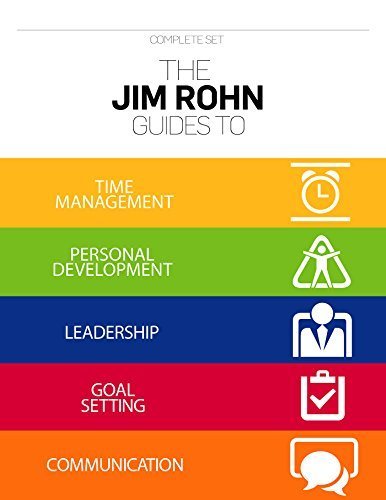
The Jim Rohn Guide Series (Time Management, Personal Development, Leadership, Goal Setting & Communication) reveals that success is not accidental but designed. By mastering time management, setting SMART goals, developing yourself daily, leading with inspiration, and communicating skillfully, you can transform your income and life. The key principle: work harder on yourself than you do on your job.
Jim Rohn, one of the most influential thinkers in personal development, built his legacy on a simple yet profound truth: You are the sum of your choices. Unlike animals driven by instinct, humans have the “dignity of choice.” This means you can design your own life—or let circumstances design it for you.
Rohn’s core message is that success is not an accident; it is the continual unfolding of the design of your own life. To achieve a better life, you must work harder on yourself than you do on your job. Here are the five essential guides to mastering that journey.
Rohn begins by reminding us that both rich and poor have 24 hours a day. The difference is in management. It’s not the hours you put in, but what you put in the hours.
Key Strategies:
Separate Majors from Minors: In sales, major time is “in the presence of the prospect.” Minor time is commuting or filing. Don’t spend major time on minor things.
Concentration: “Wherever you are, be there.” Don’t mix work and play. When you work, work. When you play, play.
The Power of “No”: Learn to say no politely to avoid overloading your calendar.
Ask Questions First: Before launching into a solution, ask questions to uncover the real problem (often two or three questions deep).
Think on Paper: Keep a journal and a projects book. Problems are solved on paper, not in your head.
Key Takeaway: Time management isn’t about squeezing more in; it’s about making yourself more valuable so you can accomplish more in less time.
Rohn’s most famous axiom is: “To have more than you’ve got, become more than you are.” Your income rarely exceeds your personal development. If you get a lucky raise but haven’t grown as a person, the money will eventually disappear.
The Three Parts of Development:
Spiritual: Acknowledge the unique human qualities of purpose and morality.
Physical: Treat your body like a temple—focus on nutrition, appearance, and health.
Mental: Stretch your mind with “heavyweight” books. Don’t just read self-help; study history, philosophy, and the other side of every argument.
The Five Abilities of Success:
Absorb: Soak up life like a sponge. Get from the day, don’t just get through it.
Respond: Let life affect you. Let sad things make you sad and happy things make you happy.
Reflect: Review your day, week, and month. Reflection adds color to your past, making it more valuable for your future.
Act: Ideas without action are worthless. Disciplined activity is the engine of success.
Share: You are not diminished by sharing; you are increased. Share books, ideas, and encouragement.
Key Takeaway: Success is solving problems. You cannot solve a problem you haven’t clearly defined.
Rohn famously learned that his bank balance was low because he had no written goals. He teaches that goals are magnets—they pull you through difficult times.
The SMART Framework:
Specific: Vague goals produce vague results.
Measurable: You must know if you are advancing.
Attainable: Just out of reach, but not out of sight.
Realistic: Must be doable given your current reality.
Time-sensitive: Every goal needs a deadline.
The Process:
Evaluation: Find a quiet place regularly to look back at where you are. “The unexamined life is not worth living.”
Dream: Make a list of what you really want, without judgment. Prioritize that list.
Accountability: Share your goals with a partner who will hold you accountable. Internal integrity is good; external accountability is better.
Key Takeaway: The major reason for setting a goal is for what it makes of you to accomplish it. The person you become is more important than the thing you get.
Leadership is the challenge to be more than mediocre. Rohn argues that leadership is now by invitation and inspiration, not by threat or intimidation.
The Balance of Leadership:
Be strong but not rude.
Be kind but not weak.
Be bold but not a bully.
Be humble but not timid.
Essential Laws:
The Law of the Harvest (Sowing & Reaping): You reap what you sow, but you reap much more than you sow. However, a hailstorm (bad luck) can wipe you out; you must have the faith to plant again next spring.
The Law of Averages: If you talk to 10 people and get 1 sale, talk to 100 and you will get 10. Make up in numbers what you lack in skill.
The 80/20 Rule: 20% of the people do 80% of the work. Give 80% of your time to the productive 20%, not the needy 80%.
Six Traits of Good Character:
Integrity, Honesty, Loyalty, Self-Sacrifice, Accountability, and Self-Control.
Key Takeaway: Don’t try to change people. You cannot change them, but they can change themselves. Your job is to inspire and teach.
If you communicate skillfully, you can “work miracles.” Preparation is the key to good communication.
Preparation (The “Four Pillars” of Input):
Interest: Sharpen your curiosity about life and people.
Fascination: Move from “does it work?” to “how does it work?”
Sensitivity: Put yourself in the other person’s shoes.
Knowledge: Store a reservoir of experiences and facts.
Verbal vs. Non-Verbal:
Words: Use colorful, optimistic, and clear language.
Tone & Pace: Vary your speed and volume to keep attention.
Body Language: Use your hands, maintain eye contact, and avoid crossing your arms (which signals closure).
The Seven Essentials for Presentations:
Know your goal.
Keep it simple (be yourself).
Be passionate and optimistic.
Balance facts with stories.
Tell stories (people remember pictures, not data).
Know your material.
Start on time and end on time.
Key Takeaway: What you do always outweighs what you say. Show that you care. Talk with people, not at them.
Jim Rohn leaves us with a simple recipe for success applicable to every guide above:
Good Ideas (Collect them).
Good Plans (Write them down).
The Passing of Time (Be patient; you cannot rush the harvest).
Solving Problems (This is the essence of success).
Ultimately, life is not about the fleeting pleasures of the moment but the deep satisfaction of earning success through discipline. The pain of discipline weighs ounces; the pain of regret weighs tons. Choose wisely.