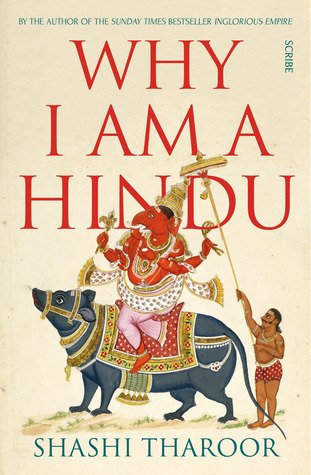
Shashi Tharoor’s Why I Am a Hindu is both a personal spiritual memoir and a powerful political critique. Written with intellectual rigor, emotional sincerity, and deep cultural insight, the book explores the essence of Hinduism as a pluralistic, inclusive, and philosophically rich tradition, and contrasts it sharply with the rise of Hindutva, a modern political ideology that seeks to redefine Hindu identity in exclusionary, nationalist, and often intolerant terms. Tharoor, a lifelong Hindu and prominent Indian politician, diplomat, and author, draws on scripture, history, personal experience, and contemporary politics to argue that true Hinduism is fundamentally at odds with the sectarian agenda of today’s majoritarian movements.
A Personal Faith, Not a Prescriptive Doctrine
Tharoor begins by clarifying that his Hinduism is not rooted in rigid dogma or ritual orthodoxy, but in lived experience. He describes a childhood immersed in the rhythms of Hindu life, festivals like Onam and Diwali, temple visits, family prayers, but without coercion or fear. His faith emerged organically through observation, conversation, and cultural osmosis. Importantly, he admits to knowing few Sanskrit mantras and relying on English translations of sacred texts. Yet this does not diminish his authenticity as a Hindu; on the contrary, it reflects Hinduism’s remarkable adaptability and lack of centralized authority. “My knowledge of Hindu sacred texts… came entirely from reading them in English translation,” he writes, adding with gentle humor that when he prays, he mixes English, Sanskrit, and Malayalam, “instinctively convinced that an omniscient God would naturally be multilingual.”
This openness is central to Tharoor’s understanding of Hinduism: it is not a monolithic religion but a civilizational ethos defined by diversity, debate, and dissent. From the Upanishads’ metaphysical inquiries to the Bhakti poets’ ecstatic devotion, from Advaita Vedanta’s non-dualism to Dvaita’s dualistic theism, Hinduism has always accommodated multiple paths to truth. As the Rig Veda declares, “Truth is one; sages call it by various names.” Tharoor emphasizes that this pluralism is not mere tolerance, it is theological affirmation. God, in the Hindu view, responds to all sincere seekers, regardless of form or name.
The Philosophical Core: Dharma, Karma, and Moksha
Tharoor delves into core Hindu concepts, not as abstract doctrines, but as living principles. He explains dharma not simply as “religion” (a misleading Western translation) but as righteous duty, ethical order, and cosmic harmony. Unlike commandments handed down from a divine judge, dharma is contextual, shaped by one’s stage of life, social role, and inner conscience. Similarly, karma is not fatalism but moral accountability: actions have consequences, and liberation (moksha) comes through selfless action, wisdom, and devotion.
He highlights the Upanishadic insight that the individual soul (atman) is one with ultimate reality (Brahman). This leads to a profound humility: if the divine dwells within all beings, then harming another is self-harm. Tharoor quotes the famous passage: “What cannot be seen with the eye, but that whereby the eye can see: Know that alone to be Brahman…” This inward turn, seeking God within rather than in external displays, defines authentic Hindu spirituality for him.
He also celebrates the Bhakti movement, which democratized spirituality by emphasizing love over ritual. Figures like Mirabai, who sang passionately to Giridhar (Krishna), or the mystic Ramana Maharshi, who taught self-inquiry (“Who am I?”), exemplify a Hinduism centered on personal experience, not priestly mediation. Tharoor sees this as evidence of Hinduism’s resilience: it constantly renews itself through saints, poets, and reformers who challenge orthodoxy in the name of deeper truth.
Hinduism as a Civilizational Refuge
One of Tharoor’s most compelling arguments is that Hindu India has historically been a sanctuary for persecuted minorities. He proudly notes that Jews fleeing Roman oppression found refuge in Kerala nearly 2,000 years ago, and Zoroastrians escaping Islamic conquest settled in Gujarat as Parsis. Neither group was forced to convert; both thrived as distinct communities under Hindu rulers. This, he insists, is not accidental, it flows from Hinduism’s inherent pluralism. “I am proud to belong to a country which has sheltered the persecuted and the refugees of all religions,” he writes, quoting Swami Vivekananda.
Vivekananda emerges as a hero in Tharoor’s narrative, a figure who synthesized ancient wisdom with modern humanitarianism. Deeply disturbed by India’s poverty and social divisions, Vivekananda declared that serving the poor was the highest form of worship. For him, national unity required transcending caste and creed. Tharoor admires this vision: a Hinduism that uplifts all, not just the privileged few.
The Distortion: From Hinduism to Hindutva
The second half of the book shifts from celebration to warning. Tharoor traces the origins of Hindutva, literally “Hindu-ness”, to early 20th-century ideologues like V.D. Savarkar, who redefined Hindu identity in ethno-nationalist terms. For Savarkar, being Hindu meant being born in India, sharing its blood and soil, and accepting India as both fatherland (pitribhumi) and holy land (punyabhumi). By this logic, Muslims and Christians, whose holy lands lie outside India, are perpetual outsiders, even if their families have lived in India for centuries.
This idea was radicalized by M.S. Golwalkar, longtime head of the Rashtriya Swayamsevak Sangh (RSS), who wrote in 1939 that non-Hindus must either assimilate completely or live as second-class citizens “without any rights.” Tharoor calls this “a travesty of Hinduism,” noting that such exclusion contradicts every inclusive principle of the faith he cherishes.
He examines how Hindutva gained political traction after independence, culminating in events like the 1992 demolition of the Babri Masjid in Ayodhya, a mosque allegedly built on the birthplace of Lord Ram. Tharoor condemns this act not only as vandalism but as a betrayal of Hindu values. True devotion, he argues, does not require destroying another’s place of worship. The Ram Janmabhoomi campaign, he insists, was less about faith and more about “incendiary politics”, using religious symbols to mobilize votes and stoke division.
Constitutional Secularism vs. Majoritarian Nationalism
Tharoor defends India’s constitutional secularism, not as Western imposition, but as the logical extension of Hindu pluralism. The Indian Constitution, he argues, doesn’t reject religion; it ensures equal respect for all. This allows Hindus to practice freely while protecting minorities from domination. In contrast, Hindutva seeks to remake India as a “Hindu Rashtra” (Hindu nation), where non-Hindus are tolerated only if they accept Hindu supremacy.
He acknowledges that Hindutva parties have risen democratically, winning elections under the very Constitution they seek to transform. This creates a paradox: can democracy be used to dismantle pluralism? Tharoor warns that if Hindutva succeeds in rewriting India’s foundational values, the result will be not unity but fragmentation, alienating 200 million Muslims, 30 million Christians, and countless others who see India as their home.
Reclaiming Hinduism
Tharoor’s conclusion is both urgent and hopeful. He calls on Hindus to reclaim their faith from political hijackers. True Hinduism, he insists, is not about building walls but bridges; not about purity but compassion; not about power but peace. It is a tradition that produced Gandhi’s nonviolence, Tagore’s universalism, and Ambedkar’s fight against caste oppression, even though Ambedkar ultimately rejected Hinduism, his critique stemmed from its failure to live up to its own ideals.
Tharoor rejects the notion that opposing Hindutva means rejecting Hinduism. On the contrary, he sees resistance to majoritarianism as the highest form of Hindu duty, upholding dharma against adharma (unrighteousness). He quotes the Bhagavad Gita: when righteousness declines, the divine incarnates to restore balance. Today, that restoration must come from ordinary Hindus who refuse to let their faith be weaponized.
Final Reflections
Why I Am a Hindu is ultimately a love letter, to a faith that embraces complexity, to a civilization that has survived millennia through adaptation, and to an idea of India that is plural, democratic, and humane. Tharoor does not deny Hinduism’s flaw, caste discrimination, gender inequality, superstitious practices, but he insists these are human corruptions, not divine mandates. The essence of Hinduism, he believes, remains its infinite capacity for renewal and inclusion.
In a time of rising intolerance, the book serves as both a shield and a compass: a shield against those who would reduce Hinduism to a tool of exclusion, and a compass pointing toward its higher truths, unity in diversity, reverence for all life, and the eternal search for the divine within. As Tharoor writes, “Hinduism is not a religion you join. It’s a culture you’re born into, a way of looking at the world, a set of values you absorb.” And those values, at their best, are universal.
In essence, Tharoor’s work is a clarion call: to distinguish between Hinduism as a spiritual, philosophical, and cultural heritage, and Hindutva as a political project that distorts that heritage for power. His Hinduism is not loud, aggressive, or insecure; it is quiet, confident, and capacious enough to hold multitudes. In defending this vision, he offers not just a defense of faith, but a blueprint for India’s soul.

Comments
1amazing