🧠 Short Summary
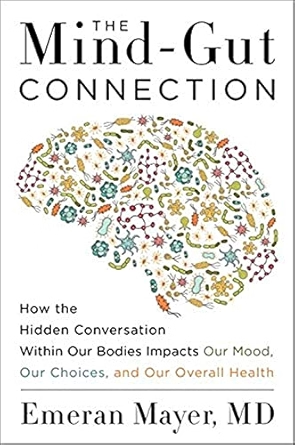
In The Mind-Gut Connection, Dr. Emeran Mayer, renowned gastroenterologist, neuroscientist, and director of the Oppenheimer Center for Stress and Resilience at UCLA, delivers a paradigm-shifting exploration of one of the most profound yet overlooked relationships in human biology: the continuous, dynamic dialogue between the brain and the gut. Far from being a passive digestive tract, the gut emerges in Mayer’s narrative as a sophisticated sensory organ, an emotional barometer, and a microbial metropolis that co-evolved with the human nervous system over millions of years. This book dismantles the centuries-old Cartesian illusion that mind and body operate independently, replacing it with an integrated, scientifically grounded model in which thoughts, emotions, microbes, food, and early life experiences converge to shape our physical health, mental well-being, and even our sense of identity.
Structured into three meticulously crafted parts, the book begins by establishing the biological infrastructure of this hidden conversation. Mayer introduces readers to the enteric nervous system (ENS), a mesh of over 100 million neurons lining the gastrointestinal tract, often dubbed “the second brain.” Unlike the central nervous system, the ENS can function autonomously, regulating digestion, immune responses, and local blood flow without input from the brain. Yet it is anything but isolated. Through the vagus nerve, the body’s information superhighway, chemical signals, neural impulses, and immune messengers travel bidirectionally between gut and brain at lightning speed. When you feel “butterflies” before a presentation or a “sinking feeling” after bad news, you are not imagining things; you are experiencing real-time physiological communication from your gut to your emotional centers.
But the true revolution in Mayer’s thesis lies in the role of the gut microbiome. Comprising trillions of bacteria, viruses, fungi, and archaea, this invisible ecosystem weighs roughly as much as the human brain and contains 150 times more genes than the human genome. These microbes are not passive tenants; they are active participants in the gut-brain dialogue. They ferment dietary fiber into short-chain fatty acids like butyrate, which reduce inflammation and strengthen the gut barrier. They synthesize neurotransmitters, including 95% of the body’s serotonin, 50% of its dopamine, and significant amounts of GABA, all of which directly modulate mood, anxiety, focus, and sleep. Critically, Mayer emphasizes that these microbes don’t just respond to our diet; they also influence our food cravings, pushing us toward sugar or fat when they are out of balance. This microbial “voice” is what he terms “microbe-speak”, a subtle but powerful language that shapes behavior, often beneath conscious awareness.
Part 2 of the book ventures into the psychological and developmental dimensions of this axis. Mayer redefines intuition not as mystical insight but as rapid, subconscious processing of gut-derived signals integrated with past emotional memories. He explains how early life experiences, particularly during the first 1,000 days of life, lay the foundation for lifelong gut-brain health. Maternal stress during pregnancy, cesarean birth, formula feeding, antibiotic use, and childhood trauma can all disrupt the delicate colonization of the infant microbiome and impair the development of stress-regulation circuits. These disruptions may predispose individuals to functional gastrointestinal disorders like irritable bowel syndrome (IBS), as well as mood disorders such as depression and anxiety. Mayer presents compelling evidence that many psychiatric conditions have a significant gut-based component, reframing them not as purely “chemical imbalances in the brain” but as systemic dysregulations rooted in the gut-immune-microbiome network.
Perhaps most provocatively, Mayer challenges the notion that emotions originate solely in the brain. Instead, he posits that emotions are embodied states, whole-body experiences in which the gut plays a starring role. Fear triggers gut motility changes; sadness slows digestion; joy enhances nutrient absorption. This perspective validates the ancient wisdom embedded in phrases like “gut feeling” or “visceral reaction,” showing they reflect actual neurobiological processes. Intuitive decision-making, then, becomes the brain’s ability to rapidly interpret these visceral signals alongside stored memories, a survival mechanism honed by evolution to guide us away from danger or toward opportunity before conscious reasoning catches up.
In Part 3, Mayer shifts from theory to practice, offering a compassionate, science-backed roadmap for optimizing brain-gut health. He contrasts the diverse, fiber-rich, seasonal diets of our hunter-gatherer ancestors, with their 100+ plant species per year, with the modern North American diet, dominated by ultra-processed foods, refined sugars, industrial seed oils, and artificial additives. This dietary shift, he argues, represents an “evolutionary mismatch”: our microbes evolved to thrive on complex plant polysaccharides, not on emulsifiers and preservatives that damage the gut lining and promote inflammation. The result is widespread dysbiosis, increased intestinal permeability (“leaky gut”), and chronic low-grade inflammation that travels via the bloodstream to the brain, contributing to brain fog, depression, and neurodegenerative diseases.
Mayer’s prescription is elegantly simple yet deeply transformative: return to a way of eating and living that honors our biological heritage. He advocates for a predominantly plant-based, Mediterranean-style diet rich in colorful vegetables, legumes, whole grains, nuts, seeds, fermented foods (like kimchi, sauerkraut, and yogurt), and polyphenol sources such as extra-virgin olive oil, dark chocolate, and berries. He stresses the importance of dietary diversity, aiming for at least 30 different plant types per week, to nourish a wide array of beneficial microbes. Beyond food, he champions mindful eating (slowing down, chewing thoroughly, eating without distraction), regular physical activity, quality sleep, and stress-reduction practices like meditation, yoga, and breathwork, all of which have been shown to enhance vagal tone, reduce inflammation, and support microbial balance.
Crucially, Mayer avoids dogmatism. He acknowledges individual variability, what works for one person may not work for another, and encourages self-experimentation guided by professional support. His goal is not perfection but harmony: cultivating a resilient internal ecosystem where brain and gut collaborate rather than conflict. In doing so, he offers more than a health manual; he provides a new philosophy of embodiment, one that invites us to listen to our bodies with curiosity, compassion, and reverence.
In an era marked by rising rates of anxiety, depression, autoimmune disease, and digestive disorders, The Mind-Gut Connection is both a wake-up call and a beacon of hope. It reminds us that healing is not always about fixing the brain or suppressing symptoms but about restoring balance to the entire system. By tuning into the quiet wisdom of our gut, we reconnect with an ancient intelligence that has guided human survival for millennia. Summary powered by VariableTribe.
Key Lessons from The Mind-Gut Connection
- The gut is a sensory organ, constantly sending data to the brain about internal and external environments.
- The microbiome produces neurotransmitters that directly regulate mood, motivation, and cognition.
- Early life shapes your gut-brain axis permanently, prenatal stress, birth method, and infant feeding matter profoundly.
- Chronic stress weakens the gut barrier, allowing bacterial fragments (LPS) to enter the bloodstream and trigger brain inflammation.
- “Gut feelings” are neurobiological signals, not metaphors, they represent rapid subconscious threat or opportunity assessment.
- Diet is the most powerful tool to reshape your microbiome within days, influencing both mental and physical health.
- Ultra-processed foods disrupt microbial balance, promote inflammation, and impair gut-brain communication.
- Mindful eating activates the parasympathetic nervous system, improving digestion and reducing stress reactivity.
- Intuition integrates gut signals with memory, it’s a form of embodied intelligence, not guesswork.
- Healing is holistic: Food, emotions, relationships, sleep, and movement all converge in the gut.
🧠 Comprehensive Analysis
Mayer’s chapter-by-chapter architecture builds a compelling arc from cellular mechanisms to daily life transformation. Chapter 1 establishes the reality of mind-body unity, citing historical figures like Hippocrates (“All disease begins in the gut”) and modern fMRI studies showing gut stimulation activating emotional brain regions. Chapters 2 and 3 detail the neural (vagus nerve), endocrine (HPA axis), and immune (cytokine signaling) pathways, while Chapter 4 introduces the microbiome as the master regulator of this dialogue.
Part 2 deepens the narrative with developmental psychology. Chapter 5 links adverse childhood experiences (ACEs) to altered gut permeability and HPA axis hyperactivity, explaining why trauma survivors often suffer from IBS or fibromyalgia. Chapter 6 redefines emotions as whole-body states, supported by research showing that people with severed vagus nerves struggle to recognize fear or disgust. Chapter 7 positions intuition as an evolved survival algorithm, faster than rational thought because it bypasses cortical processing.
Part 3 grounds theory in action. Chapter 8 celebrates ancestral diets high in fiber and phytonutrients, while Chapter 9 indicts the Standard American Diet (SAD) for its role in the global rise of chronic disease. Chapter 10 offers a “simple road” centered on diversity, mindfulness, and connection. Mayer’s core philosophy is co-evolutionary harmony: humans and microbes thrived together for millennia, and modern lifestyles have disrupted this partnership. His principles emphasize listening, nourishing, and respecting the body’s innate wisdom.
Real-world applications include using fermented foods to reduce social anxiety, practicing diaphragmatic breathing to improve IBS symptoms, and using dietary logs to identify personal food-mood triggers. Critically, Mayer avoids hype; he acknowledges that microbiome science is young but insists the evidence is strong enough to warrant lifestyle shifts. His work bridges clinical medicine, evolutionary biology, and personal empowerment, making complex science accessible without oversimplification.
Actionable Key Lessons
- Eat 30+ different plants weekly to maximize microbial diversity (e.g., spinach, lentils, almonds, blueberries, garlic).
- Practice daily vagus nerve stimulation: Humming, cold exposure, or slow exhalation (4-7-8 breathing).
- Reframe stress as a signal, not a threat, use it to prompt self-care rather than self-criticism.
- Prioritize sleep hygiene: Poor sleep reduces beneficial Lactobacillus and increases inflammatory markers.
- Cultivate social connection: Loneliness elevates cortisol and harms gut barrier function.
- Eliminate ultra-processed foods: Especially those with emulsifiers (polysorbate 80, carboxymethylcellulose) linked to leaky gut.
- Trust your gut feelings: Pause and reflect when you feel unease, it may be valuable intuitive data.
- Combine diet with mindfulness: Eat without screens, chew thoroughly, express gratitude before meals.
Practical Applications
- Daily habit: Start each meal with three deep breaths to activate the “rest-and-digest” nervous system.
- Professional integration: In corporate wellness programs, offer gut-friendly catering and mindfulness micro-breaks.
- Personal development: Keep a “gut-feeling journal” for one month, note intuitive hunches and outcomes to build self-trust.

Comments
4the followig philadelphia bar SECURITY are confirmed mob affiliated.
hack them as to take away power. disenfranchise the network. social engenering.
kung fu kneck tie
johnny brendas
barcade
as they lie to your face saying you did what you didnt do thats him. globaly. replicate.
often times there are racially bias critical stricks on “vips” for long term racial population normailzation.
Dear Web Owner,
Want more clients and customers?
We will help them find you by putting you on the 1st page of Google.
We have some special offers this season.
Email us back to get a full proposal.
Thanks!
Sabia Khan,
Business Development Consultant
no matter which buisness you make try to work for companys you start up youll never be alloud success over digital platforms when you have something too important. ive been to the end of the rabbit hole. its a brick wall.
no matter which buisness you make try to work for companys you start up youll never be alloud success over digital platforms when you have something too important. ive been to the end of the rabbit hole. its a brick wall.