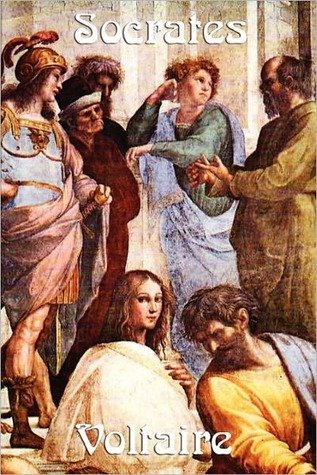
In Socrates, Voltaire reimagines the trial and death of the great philosopher as a fierce defense of reason against dogma. With wit and irony, he exposes the hypocrisy of religious and political powers that silence truth. Socrates stands firm, a martyr for free thought, while his accusers reveal their ignorance and fear. This short masterpiece challenges readers to question authority, embrace skepticism, and protect intellectual freedom. A timeless call for enlightenment in an age of darkness. Summary powered by VariableTribe
Voltaire’s Socrates is not a biography in the traditional sense, but rather a brilliant and biting philosophical satire that uses the life and death of the ancient Greek philosopher Socrates to critique religious dogma, institutional hypocrisy, and the abuse of power, particularly within organized religion and authoritarian governance. Written during the height of the Enlightenment, this concise yet powerful work reflects Voltaire’s lifelong commitment to reason, freedom of thought, and skepticism toward superstition. By reimagining key moments in Socrates’ final days, Voltaire crafts a narrative that is both a tribute to rational inquiry and a scathing indictment of those who persecute it.
At its core, Socrates serves as an allegory for the broader struggle between enlightened thinking and oppressive orthodoxy. Voltaire does not aim for historical accuracy so much as symbolic resonance. He portrays Socrates not merely as a wise Athenian teacher but as a proto-Enlightenment figure, an advocate for logic, virtue, and intellectual independence whose fate mirrors that of many thinkers persecuted throughout history for challenging established beliefs. The story unfolds with Socrates on trial, condemned by the Athenian court for corrupting the youth and impiety, culminating in his execution by hemlock poisoning. Yet Voltaire reframes these events through a satirical lens, exaggerating the absurdity of the charges and highlighting the irrationality of his accusers.
One of the most striking aspects of the text is how Voltaire juxtaposes Socrates’ calm rationality with the emotional hysteria and illogical arguments of his prosecutors. In doing so, he underscores one of his central themes: truth and wisdom are often silenced not because they are false, but because they threaten entrenched interests. The trial becomes less about justice and more about maintaining control through fear and tradition. Voltaire mocks the gods of Olympus as fictional constructs manipulated by priests and politicians to dominate the masses, a clear parallel to the abuses he saw in the Christian Church of his own time.
The character of Socrates in Voltaire’s telling is composed, ironic, and unshakably committed to reason. Even when faced with death, he remains intellectually superior, dismantling the flawed logic of his accusers with wit and clarity. His dialogues with characters like Aristophanes (portrayed here as a jealous rival) and various Athenian officials serve to expose the vanity, ignorance, and self-interest behind their accusations. Through Socratic questioning, a method rooted in probing assumptions and seeking evidence, Voltaire demonstrates how easily dogma collapses under scrutiny.
What makes Socrates particularly effective as satire is its tone. Voltaire employs irony, sarcasm, and understatement to devastating effect. When describing the divine wrath supposedly provoked by Socrates’ teachings, Voltaire writes with mock solemnity, mimicking the grandiose language of religious texts while subtly revealing its emptiness. For instance, he describes thunderbolts striking temples not as acts of godly anger, but as natural phenomena misinterpreted by superstitious minds. This blend of scientific rationalism and literary flair was revolutionary for its time and helped lay the groundwork for modern secular thought.
Another critical layer of the narrative is Voltaire’s exploration of martyrdom. Like Jesus Christ or later Enlightenment martyrs such as Jean Calas (a Protestant falsely accused and executed in France), Socrates becomes a symbol of unjust persecution. But unlike religious martyrs, whose suffering is framed as redemptive through faith, Socrates dies not for divine revelation but for the principle of free inquiry. His legacy is not salvation through belief, but progress through doubt. This distinction is crucial: Voltaire elevates skepticism as a moral virtue, positioning it against blind obedience.
Voltaire also critiques the role of public opinion in shaping justice. In Socrates, the philosopher is condemned not solely by law, but by popular sentiment inflamed by rumor and envy. The mob, swayed by theatrical accusations and moral panic, demands punishment without understanding the case. This mirrors contemporary trials Voltaire opposed, where individuals were punished based on prejudice rather than proof. By drawing this connection, he warns readers about the dangers of allowing emotion and tradition to override reason in legal and social systems.
Importantly, Socrates is not just a condemnation of ancient Athens, it is a mirror held up to 18th-century Europe. Every jab at Athenian priests echoes Voltaire’s disdain for Catholic clergy; every reference to state-enforced religion critiques the alliance between church and monarchy in France. His famous motto, “Écrasez l’infâme” (“Crush the infamous thing”), referring to institutionalized superstition, permeates this work. Though subtle in expression, the message is radical: societies that suppress free thought cannot be truly just or civilized.
Despite its serious themes, the work is infused with humor. Voltaire delights in poking fun at human folly, whether it’s a priest claiming direct communication with Zeus or a politician fearing that questioning myths might unravel social order. These comedic elements make the philosophical points more accessible and memorable, ensuring that readers are engaged even as they are challenged.
Moreover, Voltaire presents Socrates as a model educator, one who teaches not by dictating answers, but by asking questions. This pedagogical approach aligns perfectly with Enlightenment ideals of autonomy and critical thinking. Students are encouraged to think for themselves, weigh evidence, and arrive at conclusions independently. In contrast, the authorities seek passive acceptance, demanding conformity over comprehension. The tension between these two models of learning reflects a fundamental conflict in any society: should knowledge be controlled or liberated?
Socrates also touches on ethics and morality beyond religious commandments. Voltaire suggests that virtue can exist without theology, that one can live a good, principled life based on reason and empathy alone. Socrates exemplifies this ethical humanism, showing kindness, humility, and courage without appealing to divine authority. This idea was deeply controversial in Voltaire’s era, when morality was widely believed to depend on religion. By decoupling goodness from doctrine, Voltaire opens the door to secular ethics, a cornerstone of modern liberal thought.
Though brief, the text resonates far beyond its pages. It influenced generations of thinkers, writers, and reformers who championed civil liberties, separation of church and state, and educational reform. Its themes remain relevant today, especially in debates over censorship, academic freedom, and the role of religion in public life.
In essence, Socrates is both a celebration of intellectual courage and a call to vigilance. It reminds us that truth often comes at a cost and that those who challenge dominant narratives risk retaliation. But it also affirms the enduring power of ideas, how a single mind, armed with reason and integrity, can inspire centuries of progress.
Through elegant prose, incisive logic, and fearless critique, Voltaire transforms an ancient philosopher into a timeless symbol of resistance against ignorance and tyranny. Socrates is not only a reflection on the past but a guide for the future, one that urges readers to question everything, respect evidence, and defend the right to think freely. In a world still grappling with misinformation, dogmatism, and suppression of dissent, Voltaire’s voice remains urgently necessary.
Summary powered by VariableTribe