
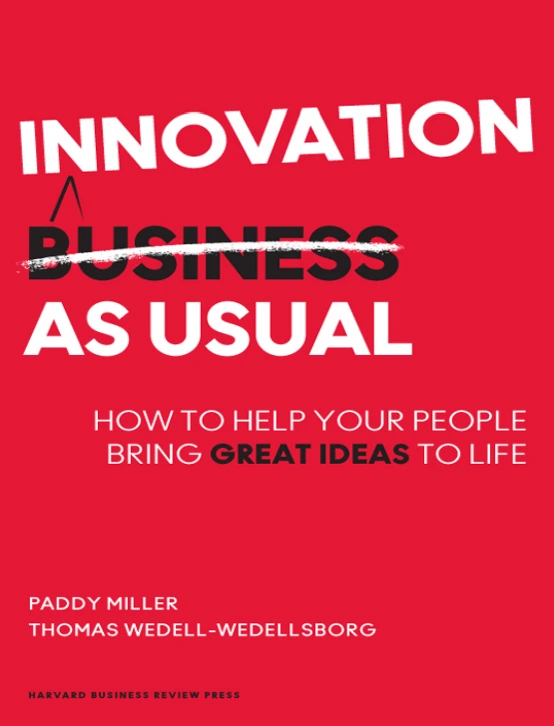
Innovation as Usual teaches how to embed innovation into daily business life. Through case studies and practical strategies, Paddy Miller and Thomas Wedell-Wedellsborg show how companies can create systems, cultures, and leadership practices that make innovation consistent, scalable, and strategic—turning breakthroughs from rare events into everyday wins.
🚀 Innovation as Usual
📖 Overview
💡 Innovation as Usual is a groundbreaking guide to making innovation not an occasional project, but a consistent part of everyday business operations . Written by strategy consultants Paddy Miller and Thomas Wedell-Wedellsborg , this book challenges the myth that innovation is something rare, magical, or reserved for R&D departments.
🏢 The authors argue that companies can—and should—build innovation into their organizational DNA so that it becomes a natural, repeatable process rather than a sporadic event.
“Innovation isn’t a lightning strike—it’s a skill you cultivate.”
Through real-world examples from global firms like LEGO, Cisco, and Ørsted, the book shows how organizations can create systems, cultures, and leadership practices that support continuous innovation.
🔍 Key Themes & Insights
Many companies treat innovation as a side activity—something special teams do in labs or offsites. But Miller and Wedell-Wedellsborg argue that real competitive advantage comes when innovation becomes routine .
🔁 Key Ideas:
🧠 Important Insight: You don’t need genius ideas every day—just good ones consistently.
A culture that encourages risk-taking, learning from failure, and open communication is essential for innovation to thrive.
🗣️ The authors emphasize that leaders must:
💬 “You can’t mandate innovation—but you can create the conditions for it.”
The book rejects the idea that only creative geniuses or startup founders innovate. Instead, it promotes the concept that everyone in the organization has the potential to contribute innovative ideas —if given the right tools and environment.
🎯 Strategies:
🧠 Important Lesson: Innovation is not a role—it’s a mindset.
Miller and Wedell-Wedellsborg introduce the concept of an “innovation engine” —a structured system that drives innovation at scale.
⚙️ It includes:
📈 This model ensures that innovation doesn’t die after the brainstorming phase.
Leadership plays a critical role—not in dictating ideas, but in designing the systems and structures that enable innovation.
📊 Leaders should:
💬 “Great leaders don’t have all the answers—they ask the right questions.”
The book strongly advocates for a fail-forward mindset —where mistakes are not punished but treated as valuable data.
📉 Key Principles:
🧠 “Failure is not the end—it’s feedback.”
Innovation often happens at the intersection of disciplines. The authors encourage cross-functional collaboration , both inside and outside the company.
🌍 Benefits:
💬 “The best ideas come from collisions—with people, with problems, with possibilities.”
Too many companies innovate without direction. The authors stress that true innovation must be strategic —aligned with long-term goals and customer needs.
📌 Questions to Ask:
🧠 Important Insight: Not all innovation is good—only the kind that matters.
Ideas mean nothing unless they’re turned into action. Innovation as Usual provides practical frameworks for moving from concept to implementation.
🚀 Tools Include:
🔁 “The goal isn’t to generate ideas—it’s to build businesses.”
📌 Final Thoughts: Innovation Isn’t Extra—It’s Essential
Innovation as Usual redefines innovation not as a luxury or a buzzword, but as a core competency that every modern organization must develop.
As the authors put it:
“If you’re not innovating constantly, you’re already falling behind.”
This book gives leaders and teams the tools to make innovation a habit—not a hype.
Whether you’re running a Fortune 500 company or a growing startup, Innovation as Usual offers a roadmap to future-proof your business through consistent, structured, and strategic innovation.