
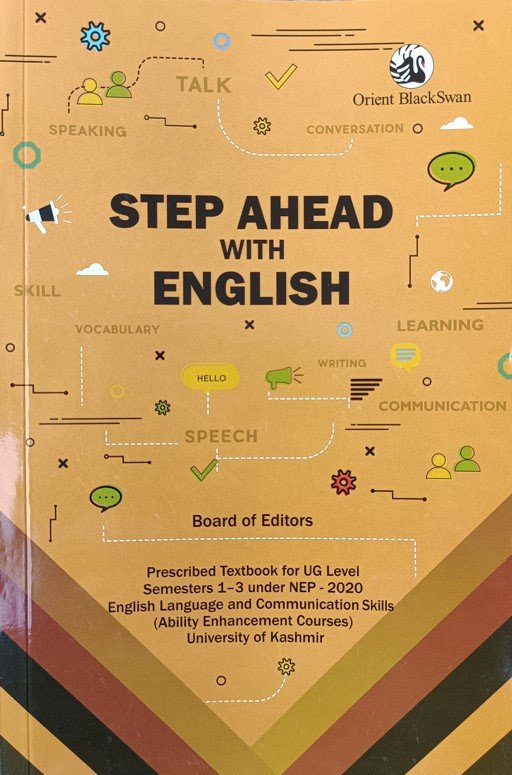
Step Ahead with English is the prescribed textbook for UG students at the University of Kashmir under NEP-2020. Designed to build essential language and communication skills, it combines literary analysis with practical writing, soft skills, and professional communication. From poetry to presentations, this comprehensive guide empowers students to think critically, express confidently, and succeed academically and professionally. A vital tool for stepping ahead in today’s competitive world.
Step Ahead with English, published by Orient BlackSwan, is a comprehensive and structured textbook designed to empower undergraduate students at the University of Kashmir with essential language proficiency and communication skills as mandated by the National Education Policy (NEP) 2020. This meticulously organized resource goes beyond traditional grammar and literature instruction to cultivate practical, real-world competencies that are crucial for academic success, professional readiness, and personal development in today’s interconnected world. The book’s title, “Step Ahead,” perfectly encapsulates its mission: to guide learners forward into confident, articulate, and effective communication across multiple domains, from literary appreciation to workplace correspondence.
The textbook is divided into two major sections, each addressing distinct yet complementary dimensions of language mastery. Section I focuses on foundational literary and linguistic skills, while Section II dives deep into applied communication, soft skills, and professional writing. This dual structure ensures that students not only understand the mechanics and artistry of the English language but also know how to wield it effectively in everyday and career-oriented contexts.
In Section I, the journey begins with Unit 1: Poetry, which introduces students to classic and contemporary verse through carefully selected works like Robert Frost’s timeless “The Road Not Taken” and Nissim Ezekiel’s evocative “Night of the Scorpion.” These selections are not merely read; they are analyzed for theme, form, and emotional resonance, encouraging critical thinking and aesthetic appreciation. The unit doesn’t just teach poetry, it teaches students how to interpret human experience through metaphor and rhythm.
Unit 2: Short Story continues this literary exploration with narrative texts such as Mulk Raj Anand’s poignant “The Lost Child” and Henry Lawson’s powerful “The Loaded Dog.” These stories serve as vehicles for understanding plot, character development, cultural context, and moral dilemmas. Through guided reading and discussion, students learn to extract meaning, empathize with diverse perspectives, and connect fictional narratives to their own lives and societal issues.
Unit 3: Language in Use shifts focus from literature to practical linguistics. It equips students with tools to navigate the complexities of everyday English through five sub-topics: Reading Comprehension, Paragraph & Essay Writing, Homonyms/Homographs/Homophones/Spelling, Idioms & Phrasal Verbs, and Spelling/Sound Patterns. This unit functions as a linguistic toolkit, helping students decode written text, express ideas coherently in writing, avoid common errors, and master the idiomatic richness of English. The inclusion of “One-Word Substitution” and sound patterns reflects an awareness of the challenges non-native speakers face, offering targeted strategies to improve both written and spoken fluency.
Transitioning to Section II: Communication Skills, the textbook moves decisively into the realm of applied knowledge. Unit 1 lays the theoretical groundwork for understanding what communication truly entails, its definition, scope, process, and common barriers. Students are introduced to concepts like verbal vs. non-verbal cues, active listening, and the importance of feedback. The unit also provides actionable “Tips for Effective Communication,” transforming abstract theory into practical habits that can be immediately implemented in classroom discussions, group projects, or social interactions.
Unit 2: Soft Skills addresses the often-overlooked but critically important interpersonal competencies required for success in academia and beyond. It covers Personality Development, Emotional Quotient (EQ), Time Management, Leadership Skills, Interpersonal Skills, Public Speaking, and techniques for Interviews, Group Discussions, and Presentations. This section recognizes that technical knowledge alone is insufficient; students must also learn to manage themselves, relate to others, lead teams, and present ideas confidently. The emphasis on EQ and leadership is particularly relevant in the NEP 2020 framework, which prioritizes holistic education over rote learning.
Finally, Unit 3: Writing Skills delivers the most pragmatic component of the book—how to write for real-world purposes. It guides students through the formats they will encounter throughout their academic and professional careers: Formal and Informal Letters, CVs, Emails, Messages, Minutes, Reports, Notices, Memoranda, and Short Speeches. Each format is explained with clear structure, tone guidelines, and examples, ensuring students can produce polished, appropriate documents whether applying for internships, submitting assignments, or communicating with professors and colleagues.
What makes Step Ahead with English stand out is its intentional alignment with the goals of NEP 2020. Rather than treating English as a subject to be studied in isolation, the book integrates it into the broader curriculum of ability enhancement. It fosters critical thinking, creativity, collaboration, and communication—the four Cs that define 21st-century education. The selection of authors, from Frost and Ezekiel to Anand and Lawson, reflects a global and multicultural perspective, exposing students to diverse voices while grounding them in universal themes of choice, identity, struggle, and resilience.
The design of the textbook is student-friendly, with clear headings, logical progression, and visual aids (as seen on the cover with icons for “Talk,” “Learning,” “Speech,” and “Communication”). The inclusion of publisher acknowledgements and a detailed table of contents suggests a collaborative effort by the Board of Editors to ensure quality and relevance. While the physical copy shown appears slightly worn, indicating frequent use, this speaks to its value as a working tool rather than a decorative shelf item.
For students at the University of Kashmir, this book is more than a syllabus requirement—it’s a companion on their educational journey. It prepares them not just to pass exams, but to participate actively in academic discourse, engage meaningfully in social settings, and compete confidently in the job market. In a region where English proficiency can open doors to higher education and employment opportunities, Step Ahead with English serves as a vital bridge between aspiration and achievement.
Ultimately, this textbook embodies the spirit of NEP 2020: learner-centric, skill-oriented, and future-ready. It doesn’t just teach students to speak or write English—it teaches them to think clearly, communicate effectively, and express themselves authentically. Whether crafting a persuasive essay, delivering a presentation, or composing a professional email, students who master this material will step ahead—not just in their studies, but in life.
Summary powered by VariableTribe