
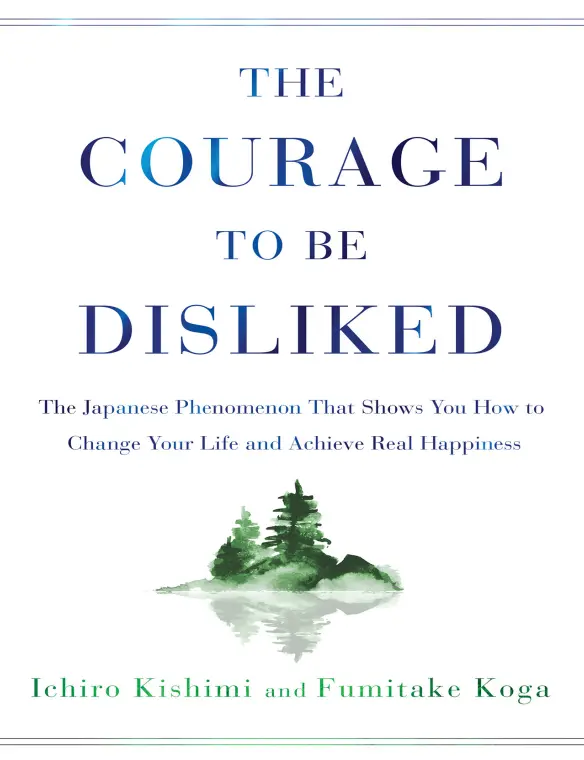
The Courage to Be Disliked challenges the belief that past trauma determines your future. Based on Alfred Adler’s psychology, this book teaches that happiness comes from taking full responsibility for your life, letting go of approval-seeking, and embracing authentic living—even if it means being disliked. Through deep yet accessible dialogue, it offers a radical path to freedom, self-respect, and meaningful connection.
The Courage to Be Disliked is a transformative book that explores the teachings of Alfred Adler , an Austrian psychotherapist and founder of Individual Psychology. Written in the form of a Socratic dialogue between a philosopher and a young man, this book challenges many commonly held beliefs about happiness, success, trauma, and relationships.
At its core, the book presents a radical but empowering idea:
You are the sole author of your life—and you have the courage to change it at any moment.
Kishimi and Koga distill Adler’s philosophy into accessible, everyday language, showing how we can break free from the chains of past trauma, the need for approval, and the illusion of fate to create our own happiness.
One of the most provocative ideas in the book is that no one else—not even your parents—can make you feel inferior or unhappy unless you give them permission .
Adlerian psychology asserts that:
This flies in the face of traditional Freudian psychology, which often focuses on how early childhood experiences shape adult behavior.
Key Insight: You are not “fated” to suffer—you choose your path, even unconsciously.
A major theme in the book is rejecting the belief that your past defines you . Many people believe they behave a certain way because of what happened to them—abandonment, abuse, neglect, or failure.
But Adler argues that these are just excuses we use to justify staying stuck. According to him, we choose our behaviors and emotions based on goals we want to achieve , not because of what happened to us
Important Lesson: It’s not what happens to you—it’s how you interpret and act on it.
This is both liberating and terrifying. It means you’re responsible for your life—but also capable of changing it.
One of the hardest truths the young man confronts in the book is that:
“The biggest lie people tell themselves is that they want to be free. What they really want is to be liked.”
We spend so much time worrying about what others think—trying to please everyone, avoiding conflict, seeking validation—that we lose ourselves.
Adlerian psychology encourages readers to live authentically , even if it means being disliked.
Key Insight: If you seek universal approval, you will never be free.
True freedom comes when you stop depending on others’ opinions and start living according to your values.
The book states that nearly all psychological distress comes from interpersonal conflicts —what others expect of us, how we compare ourselves to others, and the desire to be loved or accepted.
Adler believed that all problems are relational, and so are their solutions.
He introduced the concept of “separation of tasks” , which means:
Learning to distinguish between the two helps reduce anxiety and emotional dependency.
Important Lesson: Worry only about what is yours —not what belongs to someone else.
Another powerful idea in the book is that life is not a competition . Most people measure their worth through comparison—how much money they earn, how successful their career is, how attractive they are compared to others.
But Adlerian psychology teaches that everyone is equal , not in ability or achievement, but in value. When you stop competing and start cooperating, life becomes less stressful and more fulfilling.
Key Insight: When you see life as a journey rather than a race, happiness becomes possible.
Fear holds many people back—from pursuing dreams, building relationships, or simply speaking up. But the book suggests that fear arises when we focus too much on outcomes and not enough on action.
To overcome fear:
Important Lesson: Courage isn’t the absence of fear—it’s acting despite fear.
While the book is philosophical, its lessons are deeply practical. Here’s how to apply Adler’s principles in daily life:
Ask yourself: Am I choosing this behavior because it serves me—or because I’m clinging to old pain?
Speak your truth, set boundaries, and stop apologizing for who you are.
Focus only on what’s within your control—your actions, thoughts, and effort.
Treat people with respect, without comparing or competing.
Contribution and connection are essential to happiness—not status or perfection.
The Courage to Be Disliked is not an easy read—it challenges deeply ingrained beliefs and asks you to rethink everything you know about motivation, trauma, and happiness.
But that’s exactly why it’s so powerful.
It teaches that real freedom comes from:
As the philosopher says in the book:
“People don’t lack ability. They lack the courage to change themselves.”