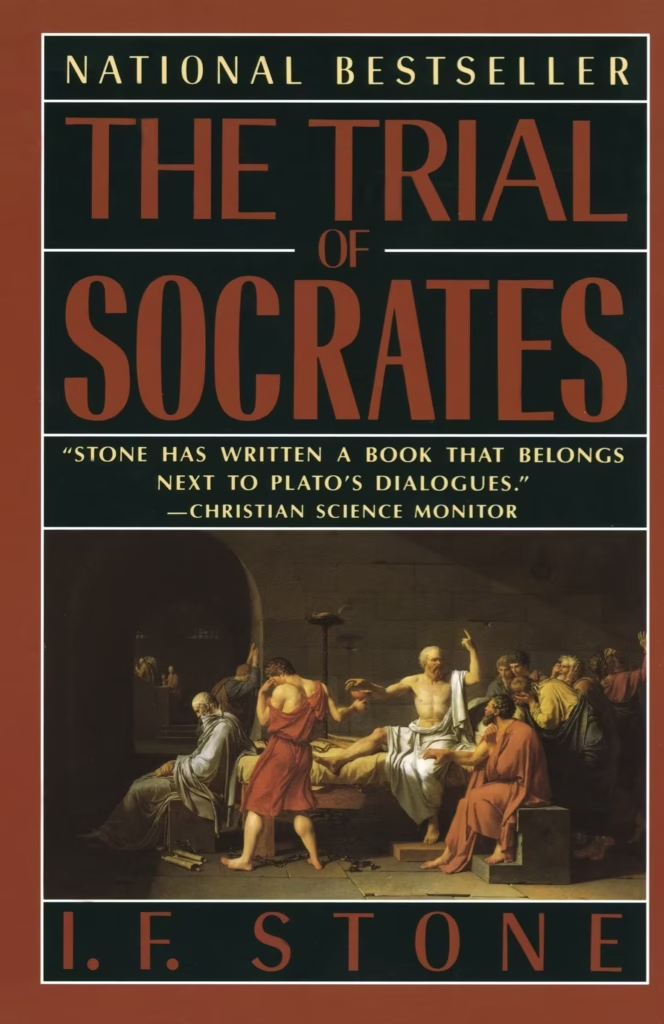
In The Trial of Socrates, I.F. Stone reexamines the legendary philosopher’s condemnation with journalistic precision and moral depth. Was Socrates a martyr for free thought or a provocateur who challenged a wounded democracy too far? Drawing on classical texts and historical insight, Stone unveils the political tensions behind the trial, revealing timeless lessons about truth, power, and civic responsibility. A profound exploration of one man’s stand against the state, and what it means for us today. Summary powered by VariableTribe
I.F. Stone’s The Trial of Socrates is a masterful blend of historical investigation, philosophical inquiry, and moral reflection that transcends its ancient subject to speak directly to modern concerns about justice, free speech, and the role of the individual in society. Far more than a retelling of a famous courtroom drama from 399 BCE, this book is an intellectual detective story, a relentless pursuit of truth through the fog of myth, bias, and political propaganda. Stone, best known as a fearless investigative journalist, applies his signature skepticism and rigorous analysis to one of the most debated events in Western history: the trial and execution of the philosopher Socrates on charges of impiety and corrupting the youth of Athens.
At first glance, the trial appears straightforward, Socrates, the gadfly of Athens, questions everything and offends the powerful; he is put on trial and sentenced to death by drinking hemlock. But Stone digs deeper, challenging the conventional narrative that has painted Socrates as a martyr for free thought. Instead, he reconstructs the political and social climate of post-war Athens, a city traumatized by defeat in the Peloponnesian War, internal strife, and the brutal rule of the Thirty Tyrants—to reveal how Socrates’ actions, however philosophically noble, were perceived as dangerously subversive by a fragile democracy trying to stabilize itself.
Stone argues that while Socrates claimed to serve Athens through his mission of questioning and truth-seeking, many of his associates had actively undermined the democratic order. Critias and Charmides, two of his former students, were key figures in the oligarchic coup that led to the reign of terror under the Thirty Tyrants. Alcibiades, another close associate, betrayed Athens multiple times during the war. Though Socrates himself never held power or advocated violence, his influence over these men cast a long shadow. In the eyes of the Athenian public, philosophy was not neutral, it was entangled with treason.
This context is crucial, Stone insists, because it reframes the trial not as a simple attack on free speech, but as a complex reckoning between a man devoted to abstract truth and a society desperate for stability. The jury of 501 citizens was not composed of tyrants or fanatics, but ordinary people who had lived through civil war, exile, and bloodshed. They feared chaos more than they revered intellectual freedom. When Socrates stood before them, he did not apologize, defend himself conventionally, or show remorse. Instead, in Plato’s account, he mocked the court, suggested he deserved a pension for his services, and refused to propose a serious alternative punishment. His defiance, while consistent with his principles, alienated the very people whose judgment he needed to survive.
Stone meticulously examines the sources—primarily Plato, Xenophon, and Aristophanes, demonstrating how each shaped the image of Socrates to suit their own agendas. Plato, the devoted disciple, elevated Socrates into a near-saintly figure, a martyr for wisdom and virtue. Xenophon portrayed him as a practical moralist, almost a proto-Spartan in discipline. Aristophanes, in his comedy The Clouds, ridiculed Socrates as a sophist who taught young men how to argue away justice and disrespect the gods. Stone shows that none of these accounts are objective; they are all interpretations colored by loyalty, ideology, or satire.
Yet rather than dismissing these texts, Stone uses them to piece together a more nuanced portrait, one that acknowledges Socrates’ greatness while refusing to ignore his provocations. He was not just a teacher of virtue but a relentless critic of consensus, democracy, and tradition. He questioned whether the gods existed, challenged the legitimacy of elected officials, and insisted that only knowledge could lead to true morality. To a recovering democracy, such ideas were not merely controversial—they were destabilizing.
One of Stone’s most provocative insights is that Socrates may have wanted to die. By provoking the court, refusing compromise, and embracing martyrdom, he ensured his legacy would outlive his body. In this reading, the trial becomes not a tragedy imposed upon him, but a final philosophical act, a demonstration of integrity even in the face of death. Socrates chose principle over survival, and in doing so, he transformed his execution into an enduring symbol of intellectual courage.
But Stone does not romanticize this choice. He asks whether such absolutism serves society. Is it responsible for a public figure to refuse dialogue, reject reconciliation, and force a community into the role of executioner? Can a man claim to love his city while scorning its institutions and leaders? These are not academic questions, they echo in every era where dissent meets authority, from Galileo to Martin Luther King Jr., from whistleblowers to journalists challenging official narratives.
Stone also explores the psychological dimension of Socrates’ behavior. Was his defiance rooted in genuine conviction, or was it a form of ego? Did he believe himself above the law because he believed himself wiser than others? There is a tension here between humility and arrogance: Socrates claimed to know nothing, yet acted as if he alone saw clearly. This paradox makes him both admirable and troubling, a thinker who dismantled illusions but offered no blueprint for rebuilding trust or governance.
What makes The Trial of Socrates so relevant today is its prescience regarding cancel culture, public outrage, and the fragility of open discourse. In an age where social media trials often precede legal ones, where reputations are destroyed in hours, and where nuance is lost in moral panic, Stone’s work serves as a cautionary tale. It reminds us that societies under stress tend to punish symbols rather than engage arguments. Socrates became a symbol, of rebellion, of elitism, of danger, and the trial was less about his actual deeds than about what he represented to a frightened populace.
Moreover, the book challenges readers to reflect on their own relationship with truth and dissent. Are we willing to tolerate uncomfortable questions? Do we protect space for unpopular ideas, even when they challenge our beliefs? Or do we, like the Athenians, silence voices we find inconvenient under the guise of protecting the common good?
Stone’s journalistic lens brings clarity without cynicism. He doesn’t absolve the Athenians of injustice, nor does he sanctify Socrates. Instead, he invites empathy for both sides, the philosopher clinging to truth, and the citizens clinging to peace. This balanced approach elevates the book beyond polemic into the realm of wisdom literature.
Another strength of the work is its accessibility. Despite dealing with dense philosophical and historical material, Stone writes with clarity, narrative momentum, and human warmth. He doesn’t lecture; he converses. He reconstructs scenes, imagines dialogues, and breathes life into ancient figures. You don’t just learn about the trial—you feel present at it.
Ultimately, The Trial of Socrates is not just about fifth-century Athens. It is about the eternal struggle between individual conscience and collective security, between innovation and tradition, between asking questions and demanding answers. It forces us to confront difficult truths: that freedom requires responsibility, that criticism must be tempered with care, and that even the wisest among us can misjudge the moment.
In a world increasingly polarized, where debate too often devolves into dogma, Stone’s message resonates with renewed urgency. True democracy depends not on unanimity, but on the ability to listen, question, and disagree without destroying one another. Socrates died for the right to ask, but Stone reminds us that the greater challenge is building societies where such questions can be heard, and answered, with patience and respect.
Summary powered by VariableTribe
This book stands as a timeless meditation on power, truth, and the cost of integrity. It does not offer easy answers, but it equips readers with the tools to think more deeply, judge more fairly, and act more wisely. For educators, leaders, activists, and anyone concerned with the health of public discourse, The Trial of Socrates is essential reading—an anchor in turbulent times.
Summary powered by VariableTribe