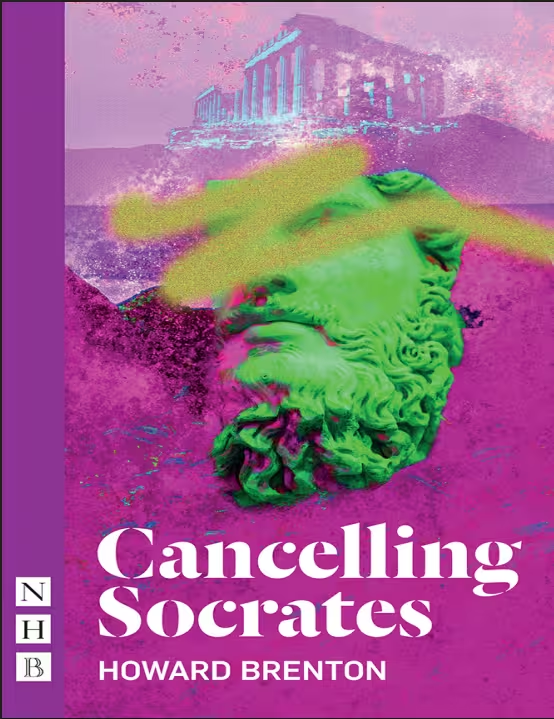
In Cancelling Socrates, Howard Brenton pits ancient wisdom against modern morality in a gripping classroom drama. When a teacher assigns Plato’s Apology, she sparks a controversy that leads to her downfall. Accused of insensitivity, she defends free thought in an age of censorship. As past and present collide, the play asks: Can we learn if we can’t question? A powerful exploration of education, identity, and the price of speaking truth. Summary powered by VariableTribe.
Howard Brenton’s Cancelling Socrates is a bold, provocative, and intellectually charged stage play that confronts one of the most urgent cultural debates of the 21st century: the tension between free speech and identity politics in modern liberal democracies. Set within the walls of a British secondary school, the drama unfolds around a veteran classics teacher, Gillian, who assigns her students Plato’s Apology, the account of Socrates’ trial and condemnation in ancient Athens. When she encourages open discussion about the text, including critiques of religion and tradition, she inadvertently ignites a firestorm that leads to accusations of Islamophobia, insensitivity, and professional misconduct. What begins as an academic exercise quickly spirals into a full-scale institutional crisis, raising profound questions about censorship, moral responsibility, and the very purpose of education.
At its heart, Cancelling Socrates draws a direct parallel between the fate of Socrates in classical Athens and the contemporary phenomenon of “cancel culture.” Just as Socrates was condemned for corrupting the youth and challenging the gods, Gillian finds herself on trial, not by law, but by public opinion, administrative procedure, and shifting social norms. The title itself is both literal and symbolic: her teaching of Socrates is cancelled, but so too is her voice, her authority, and ultimately her career. Brenton masterfully uses this historical echo to explore how societies silence dissent under the guise of protecting marginalized communities, often at the cost of intellectual freedom.
The narrative structure alternates between scenes set in the present-day classroom and staff room, and dramatic re-enactments of Socrates’ trial drawn from Plato’s dialogues. These interwoven timelines create a powerful dialogue across millennia, allowing audiences to compare the mechanisms of persecution then and now. In ancient Athens, Socrates is accused of impiety and undermining traditional values; in modern Britain, Gillian is accused of failing to respect religious sensitivities, particularly those of Muslim students, by exposing them to texts that critique divine authority. The parallels are unmistakable, yet Brenton does not offer easy answers. Instead, he forces viewers to grapple with uncomfortable truths: Can education exist without offense? Who decides what is harmful? And when does protection become suppression?
One of the play’s central conflicts arises from the character of Omar, a bright and articulate Muslim student who initially engages deeply with the material but later becomes a key figure in the campaign against Gillian. His transformation, from curious learner to vocal accuser, highlights the complex relationship between personal identity, community loyalty, and intellectual independence. Omar argues that while Socrates may have championed reason, his methods disrespect beliefs that are sacred to others. For him, the issue is not just about content, but about power: whose ideas are centered in the curriculum, and whose voices are silenced in the process.
Gillian, meanwhile, represents the Enlightenment ideal of secular rationalism. She believes in the universality of philosophical inquiry and sees the study of Socrates as essential to developing critical thinking. To her, shielding students from challenging ideas does them a disservice. “If we can’t question everything,” she insists, “then we’re not educating, we’re indoctrinating.” Her stance places her at odds not only with some parents and students but also with school administrators more concerned with reputation than principle. The headteacher, caught between legal compliance and moral ambiguity, embodies institutional cowardice, the desire to avoid controversy at all costs, even if it means sacrificing truth.
Brenton does not portray either side as entirely heroic or villainous. He resists simplistic binaries, instead presenting a nuanced portrait of a society struggling to balance competing values. On one hand, there is a legitimate need to make education inclusive and sensitive to diverse backgrounds. On the other, there is a danger in allowing emotional reactions to override reasoned debate. The play asks whether true tolerance includes tolerating ideas one finds offensive, and whether cancel culture, in its attempt to protect, might be eroding the foundations of democratic discourse.
Another layer of complexity comes from the character of Linda, a fellow teacher and friend of Gillian, who supports diversity initiatives but worries about the growing climate of fear among educators. She voices a concern shared by many in the profession: teachers are increasingly hesitant to discuss controversial topics—race, religion, gender, history, out of fear of being reported or misinterpreted. This self-censorship, the play suggests, is perhaps the most insidious consequence of cancel culture: not formal bans, but internalized restraint.
The use of classical text within the play serves multiple purposes. By quoting directly from Plato, Brenton reminds us that the struggle for intellectual freedom is ancient, not new. Socrates’ famous declaration, “The unexamined life is not worth living”, rings throughout the performance like a moral anchor. Yet the play also acknowledges that the Western canon has long excluded non-European perspectives. The curriculum debate becomes a battleground: should schools continue prioritizing dead white men, or should they reflect the multicultural reality of modern Britain?
Cancelling Socrates does not advocate for the abandonment of diversity and inclusion. Rather, it warns against replacing one orthodoxy with another. The tragedy lies not in the critique of tradition, but in the rejection of dialogue itself. When conversation shuts down and judgment replaces inquiry, everyone loses. The play ultimately mourns the erosion of the classroom as a space for exploration, risk-taking, and transformative learning.
Visually and dramatically, the production relies on minimal staging, focusing attention on language and argument. The blending of ancient and modern speech patterns creates a timeless atmosphere, reinforcing the idea that these questions transcend any single era. The ghost of Socrates looms over the action—not as a deity, but as an idea, a spirit of relentless questioning that refuses to be extinguished.
Brenton, a longtime playwright known for his political engagement and historical dramatizations (Imperium, Paul, Anne Boleyn), brings his signature blend of intellectual rigor and theatrical intensity to this work. Cancelling Socrates is not merely a commentary on education, it is a defense of the humanities in an age increasingly dominated by utilitarian thinking. It challenges audiences to consider what kind of society they want: one that protects feelings above all else, or one that values the discomfort of growth.
In the final scenes, Gillian is removed from teaching, her legacy tarnished by a process that prioritizes optics over justice. Yet the last image is quietly hopeful: a student picks up a copy of Plato and begins to read. Knowledge survives, even when institutions fail. The flame of inquiry, though dimmed, is not extinguished.
Summary powered by VariableTribe
Cancelling Socrates is a fiercely relevant work for our time, a mirror held up to the anxieties of a culture in flux. It doesn’t provide solutions, but it demands reflection. In an era where tweets can end careers and nuance is often lost in outrage, Brenton reminds us that the classroom should be a sanctuary for difficult conversations, not a no-contest zone. True education, the play insists, requires courage, to speak, to listen, and to change one’s mind.
Summary powered by VariableTribe